tkz-euclide
Points
12 Defining points using a vector
12.1 \tkzDefPointWith
Points that meet certain vector conditions are created with \tkzDefPointWith. The general principle is as follows: two points, i.e. a vector, are passed as arguments. Depending on the option, the new point forms with the first point (with some exceptions) a vector collinear or orthogonal to the first vector. Its length is either proportional to the length of the first vector, or proportional to the unit. Since this point is often only used temporarily, it does not have to be named immediately: the result is in tkzPointResult, and the macro \tkzGetPoint retrieves it under another name.
Some options set the distance between the given point and the point obtained. In the general case, this distance is the distance between the two points given as arguments; with the options of the normed type, it is 1 cm. The option \(K\) then gives multiples of this distance.
\tkzDefPointWith(⟨pt1,pt2⟩)
This macro defines a point meeting vector conditions.
| arguments | definition | explanation |
|---|---|---|
| (pt1,pt2) | point couple | the result is a point in tkzPointResult |
In what follows, it is assumed that the point is recovered by \tkzGetPoint{C}
| options | example | explanation |
|---|---|---|
| orthogonal | [orthogonal](A,B) | \(AC=AB\) and \(\overrightarrow{AC} \perp \overrightarrow{AB}\) |
| orthogonal normed | [orthogonal normed](A,B) | \(AC=1\) and \(\overrightarrow{AC} \perp \overrightarrow{AB}\) |
| linear | [linear](A,B) | \(\overrightarrow{AC}=K \times \overrightarrow{AB}\) |
| linear normed | [linear normed](A,B) | \(AC=K\) and \(\overrightarrow{AC}=k\times \overrightarrow{AB}\) |
| colinear= at #1 | [colinear= at C](A,B) | \(\overrightarrow{CD}= \overrightarrow{AB}\) |
| colinear normed= at #1 | [colinear normed= at C](A,B) | \(\overrightarrow{CD}= \overrightarrow{AB}\) |
| K | [linear](A,B),K=2 | \(\overrightarrow{AC}=2\times \overrightarrow{AB}\) |
12.1.1 Option colinear at, simple example
\((\overrightarrow{AB}=\overrightarrow{CD})\)
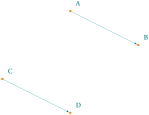
\begin{tikzpicture}[scale=1.2,

   vect/.style={->,shorten >=1pt,>=latex'}]

  \tkzDefPoint(2,3){A}   \tkzDefPoint(4,2){B}

  \tkzDefPoint(0,1){C}

  \tkzDefPointWith[colinear=at C](A,B)

  \tkzGetPoint{D}

  \tkzDrawPoints[new](A,B,C,D)

  \tkzLabelPoints[above right=3pt](A,B,C,D)

  \tkzDrawSegments[vect](A,B C,D)

\end{tikzpicture}
12.1.2 Option colinear at, complex example
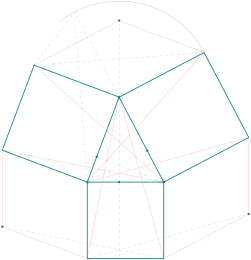
\begin{tikzpicture}[scale=.75]

\tkzDefPoints{0/0/B,3.6/0/C,1.5/4/A}

\tkzDefSpcTriangle[ortho](A,B,C){Ha,Hb,Hc}

\tkzDefTriangleCenter[ortho](A,B,C) \tkzGetPoint{H}

\tkzDefSquare(A,C) \tkzGetPoints{R}{S}

\tkzDefSquare(B,A) \tkzGetPoints{M}{N}

\tkzDefSquare(C,B) \tkzGetPoints{P}{Q}

\tkzDefPointWith[colinear= at M](A,S) \tkzGetPoint{A'}

\tkzDefPointWith[colinear= at P](B,N) \tkzGetPoint{B'}

\tkzDefPointWith[colinear= at Q](C,R) \tkzGetPoint{C'}

\tkzDefPointBy[projection=onto P--Q](Ha) \tkzGetPoint{Pa}

\tkzDrawPolygon[teal,thick](A,C,R,S)\tkzDrawPolygon[teal,thick](A,B,N,M)

\tkzDrawPolygon[teal,thick](C,B,P,Q)

\tkzDrawPoints[teal,size=2](A,B,C,Ha,Hb,Hc,A',B',C')

\tkzDrawSegments[ultra thin,red](M,A' A',S P,B' B',N Q,C' C',R B,S C,M C,N B,R A,P A,Q)

\tkzDrawSegments[ultra thin,teal, dashed](A,Ha B,Hb C,Hc)

\tkzDefPointBy[rotation=center A angle 90](S) \tkzGetPoint{S'}

\tkzDrawSegments[ultra thin,teal,dashed](B,S' A,S' A,A' M,S' B',Q P,C' M,S Ha,Pa)

\tkzDrawArc(A,S)(S')

\end{tikzpicture}
12.1.3 Option colinear at: how to use \(K\)
How to use \(K\)
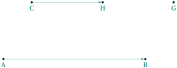
\begin{tikzpicture}[vect/.style={->,

               shorten >=1pt,>=latex'}]

  \tkzDefPoints{0/0/A,5/0/B,1/2/C}

  \tkzDefPointWith[colinear=at C](A,B)

  \tkzGetPoint{G}

  \tkzDefPointWith[colinear=at C, K=0.5](A,B)

  \tkzGetPoint{H}

  \tkzLabelPoints(A,B,C,G,H)

  \tkzDrawPoints(A,B,C,G,H)

  \tkzDrawSegments[vect](A,B C,H)

\end{tikzpicture}
12.1.4 Option colinear at with \(K=\sqrt{2}/2\)
With \(K=\frac{\sqrt{2}}{2}\)

\begin{tikzpicture}[vect/.style={->,

            shorten >=1pt,>=latex'}]

 \tkzDefPoints{1/1/A,4/2/B,2/2/C}

 \tkzDefPointWith[colinear=at C,K=sqrt(2)/2](A,B)

 \tkzGetPoint{D}

 \tkzDrawPoints[color=red](A,B,C,D)

 \tkzDrawSegments[vect](A,B C,D)

\end{tikzpicture}
12.1.5 Option orthogonal with \(K=1\)
AB=AC since \(K=1\).
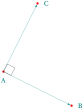
\begin{tikzpicture}[scale=1.2,

  vect/.style={->,shorten >=1pt,>=latex'}]

  \tkzDefPoints{2/3/A,4/2/B}

   \tkzDefPointWith[orthogonal,K=1](A,B)

     \tkzGetPoint{C}

   \tkzDrawPoints[color=red](A,B,C)

   \tkzLabelPoints[right=3pt](B,C)

   \tkzLabelPoints[below=3pt](A)

   \tkzDrawSegments[vect](A,B A,C)

   \tkzMarkRightAngle(B,A,C)

\end{tikzpicture}
12.1.6 Option orthogonal with \(K=-1\)
With \(K=-1\) OK=OI since \(\lvert K \rvert=1\) then OI=OJ=OK.
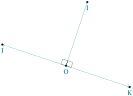
\begin{tikzpicture}[scale=.75]

  \tkzDefPoints{1/2/O,2/5/I}

  \tkzDefPointWith[orthogonal](O,I)

  \tkzGetPoint{J}

  \tkzDefPointWith[orthogonal,K=-1](O,I)

  \tkzGetPoint{K}

  \tkzDrawSegment(O,I)

  \tkzDrawSegments[->](O,J O,K)

  \tkzMarkRightAngles(I,O,J I,O,K)

  \tkzDrawPoints(O,I,J,K)

  \tkzLabelPoints(O,I,J,K)

\end{tikzpicture}
12.1.7 Option orthogonal: a more complex example
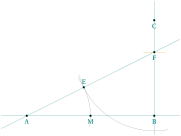
\begin{tikzpicture}[scale=.75]

  \tkzDefPoints{0/0/A,6/0/B}

  \tkzDefMidPoint(A,B)

    \tkzGetPoint{I}

  \tkzDefPointWith[orthogonal,K=-.75](B,A)

  \tkzGetPoint{C}

  \tkzInterLC(B,C)(B,I)

     \tkzGetPoints{D}{F}

  \tkzDuplicateSegment(B,F)(A,F)

  \tkzGetPoint{E}

  \tkzDrawArc[delta=10](F,E)(B)

  \tkzInterLC(A,B)(A,E)

    \tkzGetPoints{N}{M}

  \tkzDrawArc[delta=10](A,M)(E)

  \tkzDrawLines(A,B B,C A,F)

  \tkzCompass(B,F)

  \tkzDrawPoints(A,B,C,F,M,E)

  \tkzLabelPoints(A,B,C,F,M)

  \tkzLabelPoints[above](E)

\end{tikzpicture}
12.1.8 Options colinear and orthogonal
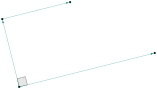
\begin{tikzpicture}[scale=1.2,

  vect/.style={->,shorten >=1pt,>=latex'}]

  \tkzDefPoints{2/1/A,6/2/B}

  \tkzDefPointWith[orthogonal,K=.5](A,B)

  \tkzGetPoint{C}

  \tkzDefPointWith[colinear=at C,K=.5](A,B)

  \tkzGetPoint{D}

  \tkzMarkRightAngle[fill=gray!20](B,A,C)

  \tkzDrawSegments[vect](A,B A,C C,D)

  \tkzDrawPoints(A,...,D)

\end{tikzpicture}
12.1.9 Option orthogonal normed
\(K=1\) \(AC=1\).

\begin{tikzpicture}[scale=1.2,

  vect/.style={->,shorten >=1pt,>=latex'}]

  \tkzDefPoints{2/3/A,4/2/B}

  \tkzDefPointWith[orthogonal normed](A,B)

  \tkzGetPoint{C}

  \tkzDrawPoints[color=red](A,B,C)

  \tkzDrawSegments[vect](A,B A,C)

  \tkzMarkRightAngle[fill=gray!20](B,A,C)

\end{tikzpicture}
12.1.10 Option orthogonal normed and K=2
\(K=2\) therefore \(AC=2\).
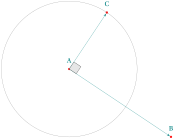
\begin{tikzpicture}[scale=1.2,

   vect/.style={->,shorten >=1pt,>=latex'}]

  \tkzDefPoints{2/3/A,5/1/B}

  \tkzDefPointWith[orthogonal normed,K=2](A,B)

  \tkzGetPoint{C}

  \tkzDrawPoints[color=red](A,B,C)

  \tkzDefCircle[R](A,2) \tkzGetPoint{a}

  \tkzDrawCircle(A,a)

  \tkzDrawSegments[vect](A,B A,C)

  \tkzMarkRightAngle[fill=gray!20](B,A,C)

  \tkzLabelPoints[above=3pt](A,B,C)

\end{tikzpicture}
12.1.11 Option linear
Here \(K=0.5\).
This amounts to applying a homothety or a multiplication of a vector by a real. Here is the midpoint of \([AB]\).
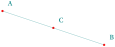
\begin{tikzpicture}[scale=1.2]

  \tkzDefPoints{1/3/A,4/2/B}

  \tkzDefPointWith[linear,K=0.5](A,B)

  \tkzGetPoint{C}

  \tkzDrawPoints[color=red](A,B,C)

  \tkzDrawSegment(A,B)

  \tkzLabelPoints[above right=3pt](A,B,C)

\end{tikzpicture}
12.1.12 Option linear normed
In the following example \(AC=1\) and \(C\) belongs to \((AB)\).
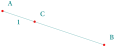
\begin{tikzpicture}[scale=1.2]

 \tkzDefPoints{1/3/A,4/2/B}

 \tkzDefPointWith[linear normed](A,B)

 \tkzGetPoint{C}

 \tkzDrawPoints[color=red](A,B,C)

 \tkzDrawSegment(A,B)

 \tkzLabelSegment(A,C){$1$}

 \tkzLabelPoints[above right=3pt](A,B,C)

\end{tikzpicture}
12.2 \tkzGetVectxy
Retrieving the coordinates of a vector.
\tkzGetVectxy(⟨\(A,B\)⟩)⟨text⟩
Gives the coordinates of a vector.
| arguments | example | explanation |
|---|---|---|
| (point){name of macro} | \tkzGetVectxy(A,B){V} | \Vx,\Vy: coordinates of \(\overrightarrow{AB}\) |
12.2.1 Coordinate transfer with \tkzGetVectxy
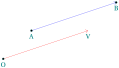
\begin{tikzpicture}

 \tkzDefPoints{0/0/O,1/1/A,4/2/B}

 \tkzGetVectxy(A,B){v}

 \tkzDefPoint(\vx,\vy){V}

 \tkzDrawSegment[->,color=red](O,V)

 \tkzDrawSegment[->,color=blue](A,B)

 \tkzDrawPoints(A,B,O)

 \tkzLabelPoints(A,B,O,V)

\end{tikzpicture}