tkz-euclide
Points
11 Definition of points by transformation
These transformations are:
translation;
homothety;
orthogonal reflection or symmetry;
central symmetry;
orthogonal projection;
rotation (degrees or radians);
inversion with respect to a circle.
11.1 \tkzDefPointBy
The transformation is chosen with the options. There are two macros: \tkzDefPointBy transforms a single point, and \tkzDefPointsBy a list of points. By default, the image of \(A\) is \(A'\). For example, we write:
\tkzDefPointBy[translation= from A to A'](B)
The result is in tkzPointResult.
\tkzDefPointBy[⟨local options⟩](⟨pt⟩)
The argument is an existing point, and its image is stored in tkzPointResult. To keep this point, \tkzGetPoint{M} gives it the name M.
| arguments | definition | examples |
|---|---|---|
| pt | existing point name | \((A)\) |
| options | examples | |
|---|---|---|
| translation | = from #1 to #2 | [translation=from A to B](E) |
| homothety | = center #1 ratio #2 | [homothety=center A ratio .5](E) |
| reflection | = over #1–#2 | [reflection=over A–B](E) |
| symmetry | = center #1 | [symmetry=center A](E) |
| projection | = onto #1–#2 | [projection=onto A–B](E) |
| rotation | = center #1 angle #2 | [rotation=center O angle 30](E) |
| rotation in rad | = center #1 angle #2 | [rotation in rad=center O angle pi/3](E) |
| rotation with nodes | = center #1 from #2 to #3 | [center O from A to B](E) |
| inversion | = center #1 through #2 | [inversion =center O through A](E) |
| inversion negative | = center #1 through #2 | ... |
The image is only defined, not drawn.
11.1.1 translation

\begin{tikzpicture}[>=latex]

 \tkzDefPoints{0/0/A,3/1/B,3/0/C}

 \tkzDefPointBy[translation= from B to A](C)

 \tkzGetPoint{D}

 \tkzDrawPoints[teal](A,B,C,D)

 \tkzLabelPoints[color=teal](A,B,C,D)

 \tkzDrawSegments[orange,->](A,B D,C)

\end{tikzpicture}
11.1.2 reflection (orthogonal symmetry)
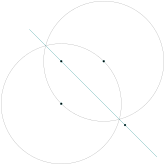
\begin{tikzpicture}[scale=.75]

 \tkzDefPoints{-2/-2/A,-1/-1/C,-4/2/D,-4/0/O}

 \tkzDrawCircle(O,A)

 \tkzDefPointBy[reflection = over C--D](A)

 \tkzGetPoint{A'}

 \tkzDefPointBy[reflection = over C--D](O)

 \tkzGetPoint{O'}

 \tkzDrawCircle(O',A')

 \tkzDrawLine[add= .5 and .5](C,D)

 \tkzDrawPoints(C,D,O,O')

\end{tikzpicture}
11.1.3 homothety and projection
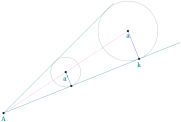
\begin{tikzpicture}

  \tkzDefPoints{0/1/A,5/3/B,3/4/C}

  \tkzDefLine[bisector](B,A,C) \tkzGetPoint{a}

  \tkzDrawLine[add=0 and 0,color=magenta!50 ](A,a)

  \tkzDefPointBy[homothety=center A ratio .5](a)

  \tkzGetPoint{a'}

  \tkzDefPointBy[projection = onto A--B](a')

  \tkzGetPoint{k'}

  \tkzDefPointBy[projection = onto A--B](a)

  \tkzGetPoint{k}

  \tkzDrawLines[add= 0 and .3](A,k A,C)

  \tkzDrawSegments[blue](a',k' a,k)

  \tkzDrawPoints(a,a',k,k',A)

  \tkzDrawCircles(a',k' a,k)

  \tkzLabelPoints(a,a',k,A)

\end{tikzpicture}
11.1.4 projection
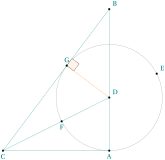
\begin{tikzpicture}[scale=1.25]

 \tkzDefPoints{0/0/A,0/4/B}

 \tkzDefTriangle[pythagore](B,A) \tkzGetPoint{C}

 \tkzDefLine[bisector](B,C,A) \tkzGetPoint{c}

 \tkzInterLL(C,c)(A,B)  \tkzGetPoint{D}

 \tkzDefPointBy[projection=onto B--C](D)

 \tkzGetPoint{G}

 \tkzInterLC(C,D)(D,A) \tkzGetPoints{E}{F}

 \tkzDrawPolygon(A,B,C)

 \tkzDrawSegment(C,D)

 \tkzDrawCircle(D,A)

 \tkzDrawSegment[new](D,G)

 \tkzMarkRightAngle[fill=orange!10](D,G,B)

 \tkzDrawPoints(A,C,F) \tkzLabelPoints(A,C,F)

 \tkzDrawPoints(B,D,E,G)

 \tkzLabelPoints[above right](B,D,E)

  \tkzLabelPoints[above](G)

 \end{tikzpicture}
11.1.5 symmetry
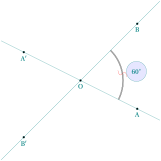
\begin{tikzpicture}[scale=1]

  \tkzDefPoints{2/-1/A,2/2/B,0/0/O}

  \tkzDefPointsBy[symmetry=center O](B,A){}

  \tkzDrawLine(A,A')

  \tkzDrawLine(B,B')

  \tkzMarkAngle[mark=s,arc=lll,

      size=1.5,mkcolor=red](A,O,B)

  \tkzLabelAngle[pos=2,circle,draw,

    fill=blue!10,font=\scriptsize](A,O,B){$60^{\circ}$}

  \tkzDrawPoints(A,B,O,A',B')

  \tkzLabelPoints(B,B')

  \tkzLabelPoints[below](A,O,A')

\end{tikzpicture}
11.1.6 rotation
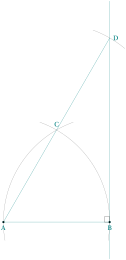
\begin{tikzpicture}[scale=0.75]

 \tkzDefPoints{0/0/A,5/0/B}

 \tkzDrawSegment(A,B)

 \tkzDefPointBy[rotation=center A angle 60](B)

 \tkzGetPoint{C}

 \tkzDefPointBy[symmetry=center C](A)

 \tkzGetPoint{D}

 \tkzDrawSegment(A,tkzPointResult)

 \tkzDrawLine(B,D)

 \tkzDrawArc(A,B)(C) \tkzDrawArc(B,C)(A)

 \tkzDrawArc(C,D)(D)

 \tkzMarkRightAngle(D,B,A)

 \tkzDrawPoints(A,B)

 \tkzLabelPoints(A,B)

 \tkzLabelPoints[above](C)

 \tkzLabelPoints[right](D)

\end{tikzpicture}
11.1.7 rotation in radian
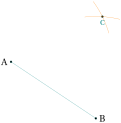
\begin{tikzpicture}

  \tkzDefPoint["$A$" left](1,5){A}

  \tkzDefPoint["$B$" right](4,3){B}

  \tkzDefPointBy[rotation in rad= center A angle pi/3](B)

  \tkzGetPoint{C}

  \tkzDrawSegment(A,B)

  \tkzDrawPoints(A,B,C)

  \tkzCompass(A,C)

  \tkzCompass(B,C)

  \tkzLabelPoints(C)

\end{tikzpicture}
11.1.8 rotation with nodes
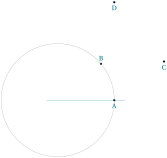
\begin{tikzpicture}

 \tkzDefPoint(0,0){O}

 \tkzDefPoint(0:2){A}

 \tkzDefPoint(40:2){B}

 \tkzDefPoint(20:4){C}

 \tkzDrawLine(O,A)

 \tkzDefPointBy[rotation with nodes%

             =center O from A to B](C)

 \tkzGetPoint{D}

\tkzDrawPoints(A,B,C,D)

\tkzDrawCircle(O,A)

\tkzLabelPoints(A,C,D)

\tkzLabelPoints[above](B)

\end{tikzpicture}
11.1.9 inversion
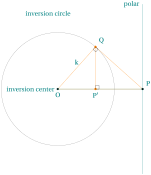
Inversion is the process of transforming points to a corresponding set of points known as their inverse points. Two points \(P\) and \(P'\) are said to be inverses with respect to an inversion circle having inversion center \(O\) and inversion radius \(k\) if \(P'\) is the perpendicular foot of the altitude of \(OQP\), where \(Q\) is a point on the circle such that \(OQ\) is perpendicular to \(PQ\).
The quantity \(k^2\) is known as the circle power (Coxeter 1969, p. 81).
(https://mathworld.wolfram.com/Inversion.html)
Some propositions:
The inverse of a circle (not through the center of inversion) is a circle.
The inverse of a circle through the center of inversion is a line.
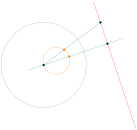
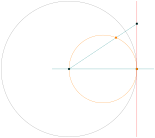
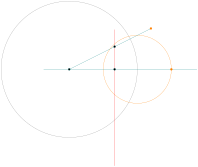
The inverse of a line (not through the center of inversion) is a circle through the center of inversion.
A circle orthogonal to the circle of inversion is its own inverse.
A line through the center of inversion is its own inverse.
Angles are preserved in inversion.
Explanation:
Directly: (center \(O\), power \(k^2={OA}^2=OP \times OP'\))
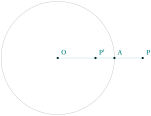
\begin{tikzpicture}[scale=.5]

  \tkzDefPoints{4/0/A,6/0/P,0/0/O}

  \tkzDefPointBy[inversion = center O through A](P)

  \tkzGetPoint{P'}

  \tkzDrawSegments(O,P)

  \tkzDrawCircle(O,A)

  \tkzLabelPoints[above right,font=\scriptsize](O,A,P,P')

  \tkzDrawPoints(O,A,P,P')

\end{tikzpicture}
\begin{tikzpicture}[scale=.5]

  \tkzDefPoints{4/0/A,6/0/P,0/0/O}

  \tkzDefLine[orthogonal=through P](O,P)

  \tkzGetPoint{L}

  \tkzDefLine[tangent from = P](O,A) \tkzGetPoints{R}{Q}

  \tkzDefPointBy[projection=onto O--A](Q) \tkzGetPoint{P'}

  \tkzDrawSegments(O,P O,A)

  \tkzDrawSegments[new](O,P O,Q P,Q Q,P')

  \tkzDrawCircle(O,A)

  \tkzDrawLines[add=1 and 0](P,L)

  \tkzLabelPoints[below,font=\scriptsize](O,P')

  \tkzLabelPoints[above right,font=\scriptsize](P,Q)

  \tkzDrawPoints(O,P) \tkzDrawPoints[new](Q,P')

  \tkzLabelSegment[above](O,Q){$k$}

  \tkzMarkRightAngles(A,P',Q P,Q,O)

  \tkzLabelCircle[above=.5cm,

      font=\scriptsize](O,A)(100){inversion circle}

  \tkzLabelPoint[left,font=\scriptsize](O){inversion center}

  \tkzLabelPoint[left,font=\scriptsize](L){polar}

\end{tikzpicture}
11.1.10 inversion of lines: example 1
\begin{tikzpicture}[scale=.5]

\tkzDefPoints{0/0/O,3/0/I,4/3/P,6/-3/Q}

\tkzDrawCircle(O,I)

\tkzDefPointBy[projection= onto P--Q](O) \tkzGetPoint{A}

\tkzDefPointBy[inversion = center O through I](A)

\tkzGetPoint{A'}

\tkzDefPointBy[inversion = center O through I](P)

\tkzGetPoint{P'}

\tkzDefCircle[diameter](O,A')\tkzGetPoint{o}

\tkzDrawCircle[new](o,A')

\tkzDrawLines[add=.25 and .25,red](P,Q)

\tkzDrawLines[add=.25 and .25](O,A)

\tkzDrawSegments(O,P)

\tkzDrawPoints(A,P,O) \tkzDrawPoints[new](A',P')

\end{tikzpicture}
11.1.11 inversion of lines: example 2
\begin{tikzpicture}[scale=.8]

\tkzDefPoints{0/0/O,3/0/I,3/2/P,3/-2/Q}

\tkzDrawCircle(O,I)

\tkzDefPointBy[projection= onto P--Q](O) \tkzGetPoint{A}

\tkzDefPointBy[inversion = center O through I](A)

\tkzGetPoint{A'}

\tkzDefPointBy[inversion = center O through I](P)

\tkzGetPoint{P'}

\tkzDefCircle[diameter](O,A')\tkzGetPoint{o}

\tkzDrawCircle[new](o,A')

\tkzDrawLines[add=.25 and .25,red](P,Q)

\tkzDrawLines[add=.25 and .25](O,A)

\tkzDrawSegments(O,P)

\tkzDrawPoints(A,P,O) \tkzDrawPoints[new](A',P')

\end{tikzpicture}
11.1.12 inversion of lines: example 3
\begin{tikzpicture}[scale=.8]

\tkzDefPoints{0/0/O,3/0/I,2/1/P,2/-2/Q}

\tkzDrawCircle(O,I)

\tkzDefPointBy[projection= onto P--Q](O) \tkzGetPoint{A}

\tkzDefPointBy[inversion = center O through I](A)

\tkzGetPoint{A'}

\tkzDefPointBy[inversion = center O through I](P)

\tkzGetPoint{P'}

\tkzDefCircle[diameter](O,A')

\tkzDrawCircle[new](I,A')

\tkzDrawLines[add=.25 and .75,red](P,Q)

\tkzDrawLines[add=.25 and .25](O,A')

\tkzDrawSegments(O,P')

\tkzDrawPoints(A,P,O) \tkzDrawPoints[new](A',P')

\end{tikzpicture}
11.1.13 inversion of circle and homothety
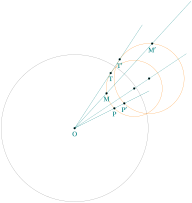
\begin{tikzpicture}[scale=.7]

\tkzDefPoints{0/0/O,3/2/A,2/1/P}

\tkzDefLine[tangent from = O](A,P) \tkzGetPoints{T}{X}

\tkzDefPointsBy[homothety = center O

                ratio 1.25](A,P,T){}

\tkzInterCC(A,P)(A',P') \tkzGetPoints{C}{D}

\tkzCalcLength(A,P)

\tkzGetLength{rAP}

\tkzDefPointOnCircle[R=center A angle 190 radius \rAP]

\tkzGetPoint{M}

\tkzDefPointBy[inversion = center O through C](M)

\tkzGetPoint{M'}

\tkzDrawCircles[new](A,P A',P')

\tkzDrawCircle(O,C)

\tkzDrawLines[add=0 and .5](O,T' O,A' O,M' O,P')

\tkzDrawPoints(A,A',P,P',O,T,T',M,M')

\tkzLabelPoints(O,T,T',M,M')

\tkzLabelPoints[below](P,P')

\end{tikzpicture}
11.1.14 inversion of a triangle with respect to the incircle
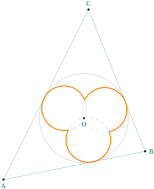
\begin{tikzpicture}[scale=1]

\tkzDefPoints{0/0/A,5/1/B,3/6/C}

\tkzDefTriangleCenter[in](A,B,C) \tkzGetPoint{O}

\tkzDefPointBy[projection= onto A--C](O) \tkzGetPoint{b}

\tkzDefPointBy[projection= onto A--C](O) \tkzGetPoint{b}

\tkzDefPointBy[projection= onto B--C](O) \tkzGetPoint{a}

\tkzDefPointBy[projection= onto A--B](O) \tkzGetPoint{c}

\tkzDefPointsBy[inversion = center O through b](a,b,c)%

                                             {Ia,Ib,Ic}

\tkzDefMidPoint(O,Ia) \tkzGetPoint{Ja}

\tkzDefMidPoint(O,Ib) \tkzGetPoint{Jb}

\tkzDefMidPoint(O,Ic) \tkzGetPoint{Jc}

\tkzInterCC(Ja,O)(Jb,O) \tkzGetPoints{O}{x}

\tkzInterCC(Ja,O)(Jc,O) \tkzGetPoints{y}{O}

\tkzInterCC(Jb,O)(Jc,O) \tkzGetPoints{O}{z}

\tkzDrawPolygon(A,B,C)

\tkzDrawCircle(O,b)\tkzDrawPoints(A,B,C,O)

\tkzDrawCircles[dashed,gray](Ja,y Jb,x Jc,z)

\tkzDrawArc[line width=1pt,orange,delta=0](Jb,x)(z)

\tkzDrawArc[line width=1pt,orange,delta=0](Jc,z)(y)

\tkzDrawArc[line width=1pt,orange,delta=0](Ja,y)(x)

\tkzLabelPoint[below](A){$A$}\tkzLabelPoint[above](C){$C$}

\tkzLabelPoint[right](B){$B$}\tkzLabelPoint[below](O){$O$}

\end{tikzpicture}
11.1.15 inversion: orthogonal circle with inversion circle
The inversion circle itself, circles orthogonal to it, and lines through the inversion center are invariant under inversion. If a circle meets the circle of inversion, the points of intersection are invariant, so they also lie on the inverse circle: see \(I\) and \(J\) in the next figure.
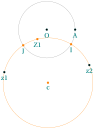
\begin{tikzpicture}[scale=1]

\tkzDefPoint(0,0){O}\tkzDefPoint(1,0){A}

\tkzDefPoint(-1.5,-1.5){z1}

\tkzDefPoint(1.5,-1.25){z2}

\tkzDefCircle[orthogonal through=z1 and z2](O,A)

\tkzGetPoint{c}

\tkzDrawCircle[new](c,z1)

\tkzDefPointBy[inversion =  center O through A](z1)

\tkzGetPoint{Z1}

\tkzInterCC(O,A)(c,z1) \tkzGetPoints{I}{J}

\tkzDefPointBy[inversion =  center O through A](I)

\tkzGetPoint{I'}

\tkzDrawCircle(O,A)

\tkzDrawPoints(O,A,z1,z2)

\tkzDrawPoints[new](c,Z1,I,J)

\tkzLabelPoints(O,A,z1,z2,c,Z1,I,J)

\end{tikzpicture}
For a more complex example, see Pappus 51.25.
11.1.16 inversion negative
It is an inversion followed by a symmetry with center \(O\).
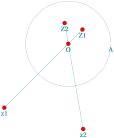
\begin{tikzpicture}[scale=1.5]

  \tkzDefPoints{1/0/A,0/0/O}

  \tkzDefPoint(-1.5,-1.5){z1}

  \tkzDefPoint(0.35,-2){z2}

  \tkzDefPointBy[inversion negative = center O through A](z1)

  \tkzGetPoint{Z1}

  \tkzDefPointBy[inversion negative = center O through A](z2)

  \tkzGetPoint{Z2}

  \tkzDrawCircle(O,A)

  \tkzDrawPoints[color=black, fill=red,size=4](Z1,Z2)

  \tkzDrawSegments(z1,Z1 z2,Z2)

  \tkzDrawPoints[color=black, fill=red,size=4](O,z1,z2)

  \tkzLabelPoints[font=\scriptsize](O,A,z1,z2,Z1,Z2)

\end{tikzpicture}
11.2 Transformation of multiple points: \tkzDefPointsBy
A variant of the previous macro, to define several images. You give the names of the images as arguments, or leave the argument empty: the names of the images are then formed from the names of the original points.
\tkzDefPointsBy[translation= from A to A'](B,C){}
The images are \(B'\) and \(C'\).
\tkzDefPointsBy[translation= from A to A'](B,C){D,E}
The images are \(D\) and \(E\).
\tkzDefPointsBy[translation= from A to A'](B)
The image is \(B'\).
\tkzDefPointsBy[⟨local options⟩](⟨list of points⟩){⟨list of points⟩}
| arguments | examples | |
|---|---|---|
| (⟨list of points⟩){⟨list of pts⟩} | (A,B){E,F} | \(E\),\(F\) images of \(A\), \(B\) |
If the list of images is empty, the name of each image is the name of the original point followed by " ’ ".
| options | examples | |
|---|---|---|
| translation = from #1 to #2 | [translation=from A to B](E){} | |
| homothety = center #1 ratio #2 | [homothety=center A ratio .5](E){F} | |
| reflection = over #1–#2 | [reflection=over A–B](E){F} | |
| symmetry = center #1 | [symmetry=center A](E){F} | |
| projection = onto #1–#2 | [projection=onto A–B](E){F} | |
| rotation = center #1 angle #2 | [rotation=center angle 30](E){F} | |
| rotation in rad = center #1 angle #2 | for instance angle pi/3 | |
| rotation with nodes = center #1 from #2 to #3 | [center O from A to B](E){F} | |
| inversion = center #1 through #2 | [inversion = center O through A](E){F} | |
| inversion negative = center #1 through #2 | ... |
The points are only defined, not drawn.
11.2.1 translation of multiple points
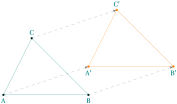
\begin{tikzpicture}[>=latex]

 \tkzDefPoints{0/0/A,3/0/B,3/1/A',1/2/C}

 \tkzDefPointsBy[translation= from A to A'](B,C){}

 \tkzDrawPolygon(A,B,C)

 \tkzDrawPolygon[new](A',B',C')

 \tkzDrawPoints(A,B,C)

 \tkzDrawPoints[new](A',B',C')

 \tkzLabelPoints(A,B,A',B')

 \tkzLabelPoints[above](C,C')

 \tkzDrawSegments[color = gray,->,

              style=dashed](A,A' B,B' C,C')

\end{tikzpicture}
11.2.2 symmetry of multiple points: an oval
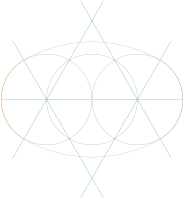
\begin{tikzpicture}[scale=0.4]

  \tkzDefPoint(-4,0){I}

  \tkzDefPoint(4,0){J}

  \tkzDefPoint(0,0){O}

  \tkzInterCC(J,O)(O,J) \tkzGetPoints{L}{H}

  \tkzInterCC(I,O)(O,I) \tkzGetPoints{K}{G}

  \tkzInterLL(I,K)(J,H) \tkzGetPoint{M}

  \tkzInterLL(I,G)(J,L) \tkzGetPoint{N}

  \tkzDefPointsBy[symmetry=center J](L,H){D,E}

  \tkzDefPointsBy[symmetry=center I](G,K){C,F}

  \begin{scope}[line style/.style = {very thin,teal}]

    \tkzDrawLines[add=1.5 and 1.5](I,K I,G J,H J,L)

    \tkzDrawLines[add=.5 and .5](I,J)

    \tkzDrawCircles(O,I I,O J,O)

    \tkzDrawArc[delta=0,orange](N,D)(C)

    \tkzDrawArc[delta=0,orange](M,F)(E)

    \tkzDrawArc[delta=0,orange](J,E)(D)

    \tkzDrawArc[delta=0,orange](I,C)(F)

  \end{scope}

\end{tikzpicture}