tkz-euclide
Lines, triangles and polygons
14 Straight lines
Drawing straight lines is of course essential, but first we must be able to define particular lines such as mediators (perpendicular bisectors), bisectors, parallels and perpendiculars. The principle is to determine two points of the line.
14.1 Definition of straight lines
\tkzDefLine[⟨local options⟩](⟨pt1,pt2⟩) or (⟨pt1,pt2,pt3⟩)
The argument is a list of two or three points. Depending on the case, the macro defines one or two points needed to obtain the line; retrieve them with \tkzGetPoint or \tkzGetPoints. I use the term "mediator" for the perpendicular bisector of a segment.
| arguments | example | explanation |
|---|---|---|
| (⟨pt1,pt2⟩) | [mediator](⟨A,B⟩) | mediator of the segment \([A,B]\) |
| (⟨pt1,pt2,pt3⟩) | [bisector](⟨A,B,C⟩) | bisector of \(\widehat{ABC}\) |
| (⟨pt1,pt2,pt3⟩) | [altitude](⟨A,B,C⟩) | altitude from \(B\) |
| (⟨pt1⟩) | [tangent at=A](⟨O⟩) | tangent at \(A\) on the circle center \(O\) |
| (⟨pt1,pt2⟩) | [tangent from=A](⟨O,B⟩) | circle center \(O\) through \(B\) |
| options | default | definition |
|---|---|---|
| mediator | perpendicular bisector of a line segment | |
| perpendicular=through… | mediator | perpendicular to a line passing through a point |
| orthogonal=through… | mediator | see above |
| parallel=through… | mediator | parallel to a line passing through a point |
| bisector | mediator | bisector of an angle defined by three points |
| bisector out | mediator | exterior angle bisector |
| symmedian | mediator | symmedian from a vertex |
| altitude | mediator | altitude from avertex |
| euler | mediator | euler line of a triangle |
| tangent at | mediator | tangent at a point of a circle |
| tangent from | mediator | tangent from an exterior point |
| K | 1 | coefficient for the perpendicular line |
| normed | false | normalizes the created segment |
14.1.1 With mediator
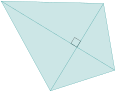
\begin{tikzpicture}[rotate=25]

 \tkzDefPoints{-2/0/A,1/2/B}

 \tkzDefLine[mediator](A,B)          \tkzGetPoints{C}{D}

 \tkzDefPointWith[linear,K=.75](C,D) \tkzGetPoint{D}

 \tkzDefMidPoint(A,B)                \tkzGetPoint{I}

 \tkzFillPolygon[color=teal!20](A,C,B,D)

 \tkzDrawSegments(A,B C,D)

 \tkzMarkRightAngle(B,I,C)

 \tkzDrawSegments(D,B D,A)

 \tkzDrawSegments(C,B C,A)

\end{tikzpicture}
14.1.2 An envelope with option mediator
Based on a figure by O. Reboux, made with pst-eucl by D. Rodriguez.
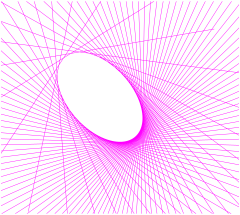
\begin{tikzpicture}[scale=.75]

   % necessary

\tkzInit[xmin=-6,ymin=-4,xmax=6,ymax=6]

\tkzClip

\tkzSetUpLine[thin,color=magenta]

\tkzDefPoint(0,0){O}

\tkzDefPoint(132:4){A}

\tkzDefPoint(5,0){B}

\foreach \ang in {5,10,...,360}{%

 \tkzDefPoint(\ang:5){M}

 \tkzDefLine[mediator](A,M)

 \tkzGetPoints{x}{y}

 \tkzDrawLine[add= 3 and 3](x,y)}

\end{tikzpicture}
14.1.3 A parabola with option mediator
Based on a figure by O. Reboux, made with pst-eucl by D. Rodriguez. It is not necessary to name the two points that define the mediator.
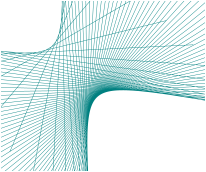
\begin{tikzpicture}[scale=.6]

\tkzInit[xmin=-6,ymin=-4,xmax=6,ymax=6]

\tkzClip

\tkzSetUpLine[thin,color=teal]

\tkzDefPoint(0,0){O}

\tkzDefPoint(132:5){A}

\tkzDefPoint(4,0){B}

\foreach \ang in {5,10,...,360}{%

 \tkzDefPoint(\ang:4){M}

 \tkzDefLine[mediator](A,M)

 \tkzGetPoints{x}{y}

 \tkzDrawLine[add= 3 and 3](x,y)}

\end{tikzpicture}
14.1.4 With options bisector and normed

\begin{tikzpicture}[rotate=25,scale=.75]

 \tkzDefPoints{0/0/C, 2/-3/A, 4/0/B}

 \tkzDefLine[bisector,normed](B,A,C) \tkzGetPoint{a}

 \tkzDrawLines[add= 0 and .5](A,B A,C)

 \tkzShowLine[bisector,gap=4,size=2,color=red](B,A,C)

 \tkzDrawLines[new,dashed,add= 0 and 3](A,a)

\end{tikzpicture}
14.1.5 With option parallel=through
Archimedes’ Book of Lemmas, Proposition 1.
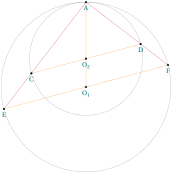
  \begin{tikzpicture}

    \tkzDefPoints{0/0/O_1,0/1/O_2,0/3/A}

    \tkzDefPoint(15:3){F}

    \tkzDefPointBy[symmetry=center O_1](F)

    \tkzGetPoint{E}

    \tkzDefLine[parallel=through O_2](E,F)

    \tkzGetPoint{x}

    \tkzInterLC(x,O_2)(O_2,A) \tkzGetPoints{D}{C}

    \tkzDrawCircles(O_1,A O_2,A)

    \tkzDrawSegments[new](O_1,A E,F C,D)

    \tkzDrawSegments[purple](A,E A,F)

    \tkzDrawPoints(A,O_1,O_2,E,F,C,D)

    \tkzLabelPoints(A,O_1,O_2,E,F,C,D)

  \end{tikzpicture}
14.1.6 With option orthogonal and parallel
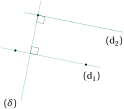
\begin{tikzpicture}

   \tkzDefPoints{-1.5/-0.25/A,1/-0.75/B,-0.7/1/C}

   \tkzDrawLine(A,B)

   \tkzLabelLine[pos=1.25,below left](A,B){$(d_1)$}

   \tkzDrawPoints(A,B,C)

   \tkzDefLine[orthogonal=through C](B,A) \tkzGetPoint{c}

   \tkzDrawLine(C,c)

   \tkzLabelLine[pos=1.25,left](C,c){$(\delta)$}

   \tkzInterLL(A,B)(C,c) \tkzGetPoint{I}

   \tkzMarkRightAngle(C,I,B)

   \tkzDefLine[parallel=through C](A,B) \tkzGetPoint{c'}

   \tkzDrawLine(C,c')

   \tkzLabelLine[pos=1.25,below left](C,c'){$(d_2)$}

   \tkzMarkRightAngle(I,C,c')

\end{tikzpicture}
14.1.7 With option altitude
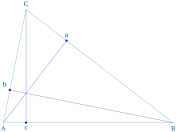
\begin{tikzpicture}

\tkzDefPoints{0/0/A,6/0/B,0.8/4/C}

\tkzDefLine[altitude](A,B,C)     \tkzGetPoint{b}

\tkzDefLine[altitude](B,C,A)     \tkzGetPoint{c}

\tkzDefLine[altitude](B,A,C)     \tkzGetPoint{a}

\tkzDrawPolygon(A,B,C)

\tkzDrawPoints[blue](a,b,c)

\tkzDrawSegments[blue](A,a B,b C,c)

\tkzLabelPoints(A,B,c)

\tkzLabelPoints[above](C,a)

\tkzLabelPoints[above left](b)

\end{tikzpicture}
14.1.8 With option euler
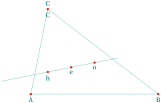
\begin{tikzpicture}[scale=.75]

\tkzDefPoints{0/0/A,6/0/B,0.8/4/C}

\tkzDefLine[euler](A,B,C)

\tkzGetPoints{h}{e}

\tkzDefTriangleCenter[circum](A,B,C)

\tkzGetPoint{o}

\tkzDrawPolygon[teal](A,B,C)

\tkzDrawPoints[red](A,B,C,h,e,o)

\tkzDrawLine[add= 2 and 2](h,e)

\tkzLabelPoints(A,B,C,h,e,o)

\tkzLabelPoints[above](C)

\end{tikzpicture}
14.1.9 Tangent passing through a point on the circle tangent at
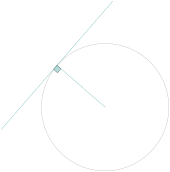
\begin{tikzpicture}[scale=.75]

  \tkzDefPoint(0,0){O}

  \tkzDefPoint(6,6){E}

  \tkzDefRandPointOn[circle=center O radius 3]

  \tkzGetPoint{A}

  \tkzDrawSegment(O,A)

  \tkzDrawCircle(O,A)

  \tkzDefLine[tangent at=A](O)

  \tkzGetPoint{h}

  \tkzDrawLine[add = 4 and 3](A,h)

  \tkzMarkRightAngle[fill=teal!30](O,A,h)

\end{tikzpicture}
14.1.10 Choice of contact point with tangents passing through an external point option tangent from
The tangent is not drawn. With the option at, a point of the tangent is given by tkzPointResult. With the option from, you get two points of the circle, tkzFirstPointResult and tkzSecondPointResult. You can choose between them by comparing the angles formed by the outer point, the contact point and the center: the two angles have opposite orientations, and the counterclockwise one corresponds to tkzFirstPointResult.
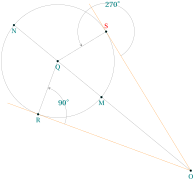
\begin{tikzpicture}[scale=1,rotate=-30]

\tkzDefPoints{0/0/Q,0/2/A,6/-1/O}

\tkzDefLine[tangent from = O](Q,A)

\tkzGetPoints{R}{S}

\tkzInterLC[near](O,Q)(Q,A)

\tkzGetPoints{M}{N}

\tkzDrawCircle(Q,M)

\tkzDrawSegments[new,add = 0 and .2](O,R O,S)

\tkzDrawSegments[gray](N,O R,Q S,Q)

\tkzDrawPoints(O,Q,R,S,M,N)

\tkzMarkAngle[gray,-stealth,size=1](O,R,Q)

\tkzFindAngle(O,R,Q)   \tkzGetAngle{an}

\tkzLabelAngle(O,R,Q){%

    $\pgfmathprintnumber{\an}^\circ$}

\tkzMarkAngle[gray,-stealth,size=1](O,S,Q)

\tkzFindAngle(O,S,Q)   \tkzGetAngle{an}

\tkzLabelAngle(O,S,Q){%

    $\pgfmathprintnumber{\an}^\circ$}

\tkzLabelPoints(Q,O,M,N,R)

\tkzLabelPoints[above,text=red](S)

\end{tikzpicture}
14.1.11 Example of tangents passing through an external point
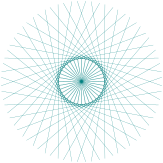
\begin{tikzpicture}[scale=.8]

\tkzDefPoints{0/0/c,1/0/d,3/0/a0}

\def\tkzRadius{1}

\tkzDrawCircle(c,d)

 \foreach \an in {0,10,...,350}{

  \tkzDefPointBy[rotation=center c angle \an](a0)

  \tkzGetPoint{a}

  \tkzDefLine[tangent from = a](c,d)

  \tkzGetPoints{e}{f}

  \tkzDrawLines(a,f a,e)

  \tkzDrawSegments(c,e c,f)}

\end{tikzpicture}
14.1.12 Example of Andrew Mertz
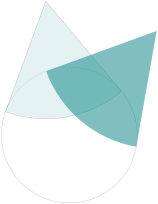
 \begin{tikzpicture}[scale=.6]

 \tkzDefPoint(100:8){A}\tkzDefPoint(50:8){B}

 \tkzDefPoint(0,0){C} \tkzDefPoint(0,-4){R}

 \tkzDrawCircle(C,R)

 \tkzDefLine[tangent from = A](C,R)  \tkzGetPoints{D}{E}

\tkzDefLine[tangent from = B](C,R)  \tkzGetPoints{F}{G}

 \tkzDrawSector[fill=teal!20,opacity=0.5](A,E)(D)

 \tkzFillSector[color=teal,opacity=0.5](B,G)(F)

 \end{tikzpicture}
http://www.texample.net/tikz/examples/
14.1.13 Drawing a tangent option tangent from

\begin{tikzpicture}[scale=.6]

 \tkzDefPoint(0,0){B}

 \tkzDefPoint(0,8){A}

 \tkzDefSquare(A,B)

 \tkzGetPoints{C}{D}

 \tkzDrawPolygon(A,B,C,D)

 \tkzClipPolygon(A,B,C,D)

 \tkzDefPoint(4,8){F}

 \tkzDefPoint(4,0){E}

 \tkzDefPoint(4,4){Q}

 \tkzFillPolygon[color = green](A,B,C,D)

 \tkzDrawCircle[fill = orange](B,A)

 \tkzDrawCircle[fill = purple](E,B)

 \tkzDefLine[tangent from = B](F,A)

 \tkzInterLL(F,tkzSecondPointResult)(C,D)

 \tkzInterLL(A,tkzPointResult)(F,E)

 \tkzDrawCircle[fill = yellow](tkzPointResult,Q)

 \tkzDefPointBy[projection= onto B--A](tkzPointResult)

 \tkzDrawCircle[fill = blue!50!black](tkzPointResult,A)

\end{tikzpicture}