tkz-euclide
Examples
51 Some interesting examples
51.1 Square root of the integers

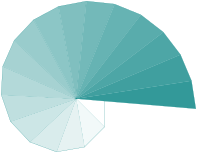
\begin{tikzpicture}

  \tkzDefPoint(0,0){O}

  \tkzDefPoint(1,0){a0}

   \tkzDrawSegment(O,a0)

  \foreach \i [count=\j] in {0,...,16}{%

    \tkzDefPointWith[orthogonal normed](a\i,O)

    \tkzGetPoint{a\j}

       \pgfmathsetmacro{\c}{5*\i}

    \tkzDrawPolySeg[fill=teal!\c](a\i,a\j,O)}

 \end{tikzpicture}
51.2 About right triangles

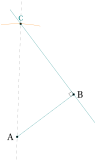
\begin{tikzpicture}[scale=.5]

  \tkzDefPoint["$A$" left](2,1){A}

  \tkzDefPoint["$B$" right](6,4){B}

  \tkzDefPointWith[orthogonal,K=-1](B,A)

  \tkzDrawLine[add = .5 and .5](B,tkzPointResult)

  \tkzInterLC[R](B,tkzPointResult)(A,8)

  \tkzGetPoints{J}{C}

  \tkzDrawSegment(A,B)

  \tkzDrawPoints(A,B,C)

  \tkzCompass(A,C)

  \tkzMarkRightAngle(A,B,C)

  \tkzDrawLine[color=gray,style=dashed](A,C)

  \tkzLabelPoint[above](C){$C$}

\end{tikzpicture}
51.3 Archimedes
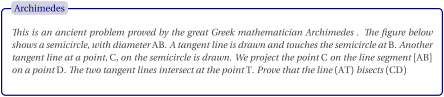
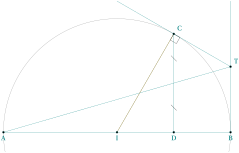
\begin{tikzpicture}[scale=1]

  \tkzDefPoint(0,0){A}\tkzDefPoint(6,0){D}

  \tkzDefPoint(8,0){B}\tkzDefPoint(4,0){I}

  \tkzDefLine[orthogonal=through D](A,D)

  \tkzInterLC[R](D,tkzPointResult)(I,4) \tkzGetSecondPoint{C}

  \tkzDefLine[orthogonal=through C](I,C)    \tkzGetPoint{c}

  \tkzDefLine[orthogonal=through B](A,B)    \tkzGetPoint{b}

  \tkzInterLL(C,c)(B,b) \tkzGetPoint{T}

  \tkzInterLL(A,T)(C,D) \tkzGetPoint{P}

  \tkzDrawArc(I,B)(A)

  \tkzDrawSegments(A,B A,T C,D I,C) \tkzDrawSegment[new](I,C)

  \tkzDrawLine[add = 1 and 0](C,T)   \tkzDrawLine[add = 0 and 1](B,T)

  \tkzMarkRightAngle(I,C,T)

  \tkzDrawPoints(A,B,I,D,C,T)

  \tkzLabelPoints(A,B,I,D)  \tkzLabelPoints[above right](C,T)

  \tkzMarkSegment[pos=.25,mark=s|](C,D) \tkzMarkSegment[pos=.75,mark=s|](C,D)

\end{tikzpicture}
51.3.1 Square and rectangle of same area; Golden section

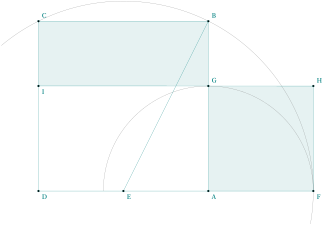
 \begin{tikzpicture}[scale=.75]

  \tkzDefPoint(0,0){D} \tkzDefPoint(8,0){A}

  \tkzDefSquare(D,A) \tkzGetPoints{B}{C}

  \tkzDefMidPoint(D,A) \tkzGetPoint{E}

  \tkzInterLC(D,A)(E,B)\tkzGetSecondPoint{F}

  \tkzInterLC[near](B,A)(A,F)\tkzGetFirstPoint{G}

  \tkzDefSquare(A,F)\tkzGetFirstPoint{H}

  \tkzInterLL(C,D)(H,G)\tkzGetPoint{I}

  \tkzFillPolygon[teal!10](I,G,B,C)

  \tkzFillPolygon[teal!10](A,F,H,G)

  \tkzDrawArc[angles](E,B)(0,120)

  \tkzDrawSemiCircle(A,F)

  \tkzDrawSegments(A,F E,B H,I F,H)

  \tkzDrawPolygons(A,B,C,D)

  \tkzDrawPoints(A,...,I)

  \tkzLabelPoints[below right](A,E,D,F,I)

  \tkzLabelPoints[above right](C,B,G,H)

 \end{tikzpicture}
51.3.2 Steiner Line and Simson Line

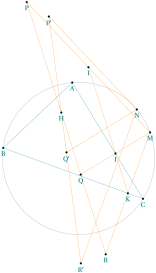
\begin{tikzpicture}[scale=.75,rotate=-20]

  \tkzDefPoint(0,0){B}

  \tkzDefPoint(2,4){A} \tkzDefPoint(7,0){C}

  \tkzDefCircle[circum](A,B,C)

  \tkzGetPoint{O}

  \tkzDrawCircle(O,A)

  \tkzCalcLength(O,A)

  \tkzGetLength{rOA}

  \tkzDefShiftPoint[O](40:\rOA){M}

  \tkzDefShiftPoint[O](60:\rOA){N}

  \tkzDefTriangleCenter[orthic](A,B,C)

  \tkzGetPoint{H}

  \tkzDefSpcTriangle[orthic,name=H](A,B,C){a,b,c}

  \tkzDefPointsBy[reflection=over A--B](M,N){P,P'}

  \tkzDefPointsBy[reflection=over A--C](M,N){Q,Q'}

  \tkzDefPointsBy[reflection=over C--B](M,N){R,R'}

  \tkzDefMidPoint(M,P)\tkzGetPoint{I}

  \tkzDefMidPoint(M,Q)\tkzGetPoint{J}

  \tkzDefMidPoint(M,R)\tkzGetPoint{K}

  \tkzDrawSegments[new](P,R M,P M,Q M,R N,P'

   N,Q' N,R' P',R' I,K)

  \tkzDrawPolygons(A,B,C)

  \tkzDrawPoints(A,B,C,H,M,N,P,Q,R,P',Q',R',I,J,K)

  \tkzLabelPoints(A,B,C,H,M,N,P,Q,R,P',Q',R',I,J,K)

\end{tikzpicture}
51.4 Lune of Hippocrates
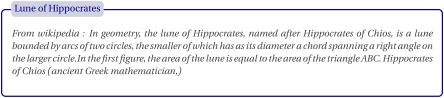
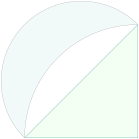
\begin{tikzpicture}

 \tkzInit[xmin=-2,xmax=5,ymin=-1,ymax=6]

 \tkzClip % allows you to define a bounding box

   % large enough

  \tkzDefPoint(0,0){A}\tkzDefPoint(4,0){B}

  \tkzDefSquare(A,B)

  \tkzGetFirstPoint{C}

  \tkzDrawPolygon[fill=green!5](A,B,C)

   \begin{scope}

     \tkzClipCircle[out](B,A)

     \tkzDefMidPoint(C,A) \tkzGetPoint{M}

     \tkzDrawSemiCircle[fill=teal!5](M,C)

   \end{scope}

   \tkzDrawArc[delta=0](B,C)(A)

\end{tikzpicture}
51.5 Lunes of Hasan Ibn al-Haytham
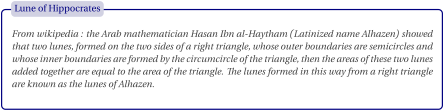
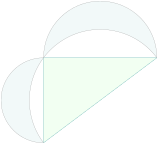
\begin{tikzpicture}[scale=.5,rotate=180]

  \tkzInit[xmin=-1,xmax=11,ymin=-4,ymax=7]

  \tkzClip

  \tkzDefPoints{0/0/A,8/0/B}

  \tkzDefTriangle[pythagore,swap](A,B)

  \tkzGetPoint{C}

  \tkzDrawPolygon[fill=green!5](A,B,C)

  \tkzDefMidPoint(C,A) \tkzGetPoint{I}

  \begin{scope}

    \tkzClipCircle[out](I,A)

    \tkzDefMidPoint(B,A) \tkzGetPoint{x}

    \tkzDrawSemiCircle[fill=teal!5](x,A)

    \tkzDefMidPoint(B,C) \tkzGetPoint{y}

    \tkzDrawSemiCircle[fill=teal!5](y,B)

  \end{scope}

  \tkzSetUpCompass[/tkzcompass/delta=0]

      \tkzDefMidPoint(C,A) \tkzGetPoint{z}

  \tkzDrawSemiCircle(z,A)

\end{tikzpicture}
51.6 About clipping circles

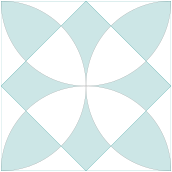
\begin{tikzpicture}

  \tkzInit[xmin=0,xmax=6,ymin=0,ymax=6]

  \tkzClip

  \tkzDefPoints{0/0/A, 6/0/B}

  \tkzDefSquare(A,B)      \tkzGetPoints{C}{D}

  \tkzDefMidPoint(A,B)        \tkzGetPoint{M}

  \tkzDefMidPoint(A,D)        \tkzGetPoint{N}

  \tkzDefMidPoint(B,C)        \tkzGetPoint{O}

  \tkzDefMidPoint(C,D)        \tkzGetPoint{P}

 \begin{scope}

  \tkzClipCircle[out](M,B) \tkzClipCircle[out](P,D)

  \tkzFillPolygon[teal!20](M,N,P,O)

 \end{scope}

 \begin{scope}

   \tkzClipCircle[out](N,A) \tkzClipCircle[out](O,C)

   \tkzFillPolygon[teal!20](M,N,P,O)

 \end{scope}

 \begin{scope}

   \tkzClipCircle(P,C) \tkzClipCircle(N,A)

   \tkzFillPolygon[teal!20](N,P,D)

 \end{scope}

 \begin{scope}

     \tkzClipCircle(O,C) \tkzClipCircle(P,C)

     \tkzFillPolygon[teal!20](P,C,O)

 \end{scope}

 \begin{scope}

     \tkzClipCircle(M,B)  \tkzClipCircle(O,B)

     \tkzFillPolygon[teal!20](O,B,M)

 \end{scope}

 \begin{scope}

     \tkzClipCircle(N,A) \tkzClipCircle(M,A)

     \tkzFillPolygon[teal!20](A,M,N)

 \end{scope}

 \tkzDrawSemiCircles(M,B N,A O,C P,D)

 \tkzDrawPolygons(A,B,C,D M,N,P,O)

 \end{tikzpicture}
51.7 Similar isosceles triangles

The following is from the excellent site Descartes et les Mathématiques. I did not modify the text; I only programmed the figures.
http://debart.pagesperso-orange.fr/seconde/triangle.html
Bibliography:
Géométrie au Bac - Tangente, special issue no. 8 - Exercise 11, page 11
Elisabeth Busser and Gilles Cohen: 200 nouveaux problèmes du "Monde" - POLE 2007 (200 new problems of "Le Monde")
Affaire de logique n° 364 - Le Monde February 17, 2004
Two statements were proposed, one by the magazine Tangente and the other by Le Monde.
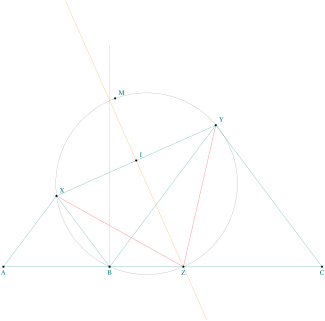
Editor of the magazine "Tangente": Two similar isosceles triangles \(AXB\) and \(BYC\) are constructed with main vertices \(X\) and \(Y\), such that \(A\), \(B\) and \(C\) are aligned and that these triangles are "indirect". Let \(\alpha\) be the vertex angle \(\widehat{AXB}\) = \(\widehat{BYC}\). We then construct a third isosceles triangle \(XZY\), similar to the first two, with main vertex \(Z\) and "indirect". Prove that the point \(Z\) lies on the straight line \((AC)\).
Editor of "Le Monde": We construct two similar isosceles triangles \(AXB\) and \(BYC\) with principal vertices \(X\) and \(Y\), such that \(A\), \(B\) and \(C\) are aligned and that these triangles are "indirect". Let \(\alpha\) be the vertex angle \(\widehat{AXB}\) = \(\widehat{BYC}\). The point \(Z\) of the segment \([AC]\) is equidistant from the two vertices \(X\) and \(Y\).
At what angle does it see these two vertices?
The constructions and their codes are on the next two pages, but you can search before looking. In both cases, the programming follows my reasoning (I think...).
51.8 Revised version of "Tangente"
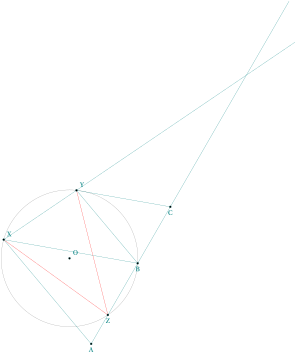
\begin{tikzpicture}[scale=.8,rotate=60]

  \tkzDefPoint(6,0){X}   \tkzDefPoint(3,3){Y}

  \tkzDefShiftPoint[X](-110:6){A}    \tkzDefShiftPoint[X](-70:6){B}

  \tkzDefShiftPoint[Y](-110:4.2){A'} \tkzDefShiftPoint[Y](-70:4.2){B'}

  \tkzDefPointBy[translation= from A' to B ](Y) \tkzGetPoint{Y}

  \tkzDefPointBy[translation= from A' to B ](B') \tkzGetPoint{C}

  \tkzInterLL(A,B)(X,Y) \tkzGetPoint{O}

  \tkzDefMidPoint(X,Y) \tkzGetPoint{I}

  \tkzDefPointWith[orthogonal](I,Y)

  \tkzInterLL(I,tkzPointResult)(A,B) \tkzGetPoint{Z}

  \tkzDefCircle[circum](X,Y,B) \tkzGetPoint{O}

  \tkzDrawCircle(O,X)

  \tkzDrawLines[add = 0 and 1.5](A,C) \tkzDrawLines[add = 0 and 3](X,Y)

  \tkzDrawSegments(A,X B,X B,Y C,Y)   \tkzDrawSegments[color=red](X,Z Y,Z)

  \tkzDrawPoints(A,B,C,X,Y,O,Z)

  \tkzLabelPoints(A,B,C,Z)   \tkzLabelPoints[above right](X,Y,O)

\end{tikzpicture}
51.9 "Le Monde" version
\begin{tikzpicture}[scale=1.25]

  \tkzDefPoint(0,0){A}

  \tkzDefPoint(3,0){B}

  \tkzDefPoint(9,0){C}

  \tkzDefPoint(1.5,2){X}

  \tkzDefPoint(6,4){Y}

  \tkzDefCircle[circum](X,Y,B) \tkzGetPoint{O}

  \tkzDefMidPoint(X,Y)               \tkzGetPoint{I}

  \tkzDefPointWith[orthogonal](I,Y)  \tkzGetPoint{i}

  \tkzDrawLines[add = 2 and 1,color=orange](I,i)

  \tkzInterLL(I,i)(A,B)              \tkzGetPoint{Z}

  \tkzInterLC(I,i)(O,B)              \tkzGetFirstPoint{M}

  \tkzDefPointWith[orthogonal](B,Z)  \tkzGetPoint{b}

  \tkzDrawCircle(O,B)

  \tkzDrawLines[add = 0 and 2,color=orange](B,b)

  \tkzDrawSegments(A,X B,X B,Y C,Y A,C X,Y)

  \tkzDrawSegments[color=red](X,Z Y,Z)

  \tkzDrawPoints(A,B,C,X,Y,Z,M,I)

  \tkzLabelPoints(A,B,C,Z)

  \tkzLabelPoints[above right](X,Y,M,I)

\end{tikzpicture}
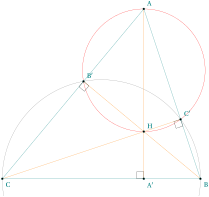
51.10 Triangle altitudes

\begin{tikzpicture}

   \tkzDefPoint(0,0){C} \tkzDefPoint(7,0){B}

   \tkzDefPoint(5,6){A}

   \tkzDefMidPoint(C,B) \tkzGetPoint{I}

   \tkzInterLC(A,C)(I,B)

   \tkzGetFirstPoint{B'}

   \tkzInterLC(A,B)(I,B)

   \tkzGetSecondPoint{C'}

   \tkzInterLL(B,B')(C,C') \tkzGetPoint{H}

   \tkzInterLL(A,H)(C,B) \tkzGetPoint{A'}

   \tkzDefCircle[circum](A,B',C') \tkzGetPoint{O}

   \tkzDrawArc(I,B)(C)

   \tkzDrawPolygon(A,B,C)

   \tkzDrawCircle[color=red](O,A)

   \tkzDrawSegments[color=orange](B,B' C,C' A,A')

   \tkzMarkRightAngles(C,B',B B,C',C C,A',A)

   \tkzDrawPoints(A,B,C,A',B',C',H)

   \tkzLabelPoints[above right](A,B',C',H)

   \tkzLabelPoints[below right](B,C,A')

\end{tikzpicture}
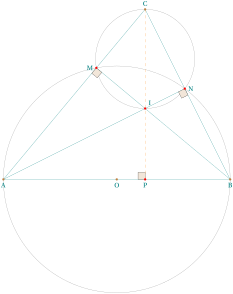
51.11 Altitudes - other construction
\begin{tikzpicture}

\tkzDefPoint(0,0){A} \tkzDefPoint(8,0){B}

\tkzDefPoint(5,6){C}

\tkzDefMidPoint(A,B)\tkzGetPoint{O}

\tkzDefPointBy[projection=onto A--B](C) \tkzGetPoint{P}

\tkzInterLC[common=A](C,A)(O,A)

\tkzGetFirstPoint{M}

\tkzInterLC(C,B)(O,A)

\tkzGetSecondPoint{N}

\tkzInterLL(B,M)(A,N)\tkzGetPoint{I}

\tkzDefCircle[diameter](A,B)\tkzGetPoint{x}

\tkzDefCircle[diameter](I,C)\tkzGetPoint{y}

\tkzDrawCircles(x,A y,C)

\tkzDrawSegments(C,A C,B A,B B,M A,N)

\tkzMarkRightAngles[fill=brown!20](A,M,B A,N,B A,P,C)

\tkzDrawSegment[style=dashed,color=orange](C,P)

\tkzLabelPoints(O,A,B,P)

\tkzLabelPoint[left](M){$M$}

\tkzLabelPoint[right](N){$N$}

\tkzLabelPoint[above](C){$C$}

\tkzLabelPoint[above right](I){$I$}

\tkzDrawPoints[color=red](M,N,P,I)

\tkzDrawPoints[color=brown](O,A,B,C)

\end{tikzpicture}
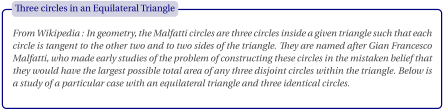
51.12 Three circles in an equilateral triangle
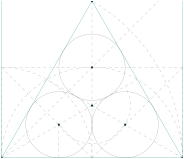
\begin{tikzpicture}[scale=.8]

  \tkzDefPoints{0/0/A,8/0/B,0/4/a,8/4/b,8/8/c}

  \tkzDefTriangle[equilateral](A,B) \tkzGetPoint{C}

  \tkzDefMidPoint(A,B) \tkzGetPoint{M}

  \tkzDefMidPoint(B,C) \tkzGetPoint{N}

  \tkzDefMidPoint(A,C) \tkzGetPoint{P}

  \tkzInterLL(A,N)(M,a) \tkzGetPoint{Ia}

  \tkzDefPointBy[projection = onto A--B](Ia)

  \tkzGetPoint{ha}

  \tkzInterLL(B,P)(M,b) \tkzGetPoint{Ib}

  \tkzDefPointBy[projection = onto A--B](Ib)

  \tkzGetPoint{hb}

  \tkzInterLL(A,c)(M,C) \tkzGetPoint{Ic}

  \tkzDefPointBy[projection = onto A--C](Ic)

  \tkzGetPoint{hc}

  \tkzInterLL(A,Ia)(B,Ib) \tkzGetPoint{G}

  \tkzDefSquare(A,B) \tkzGetPoints{D}{E}

  \tkzDrawPolygon(A,B,C)

  \tkzClipBB

  \tkzDrawSemiCircles[gray,dashed](M,B A,M

  A,B B,A G,Ia)

  \tkzDrawCircles[gray](Ia,ha Ib,hb Ic,hc)

  \tkzDrawPolySeg(A,E,D,B)

  \tkzDrawPoints(A,B,C,G,Ia,Ib,Ic)

  \tkzDrawSegments[gray,dashed](C,M A,N B,P

   M,a M,b A,a a,b b,B A,D Ia,ha)

\end{tikzpicture}
51.13 Law of sines

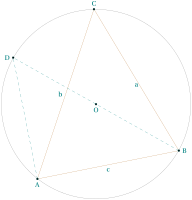
  \begin{tikzpicture}

  \tkzDefPoints{0/0/A,5/1/B,2/6/C}

  \tkzDefTriangleCenter[circum](A,B,C)

   \tkzGetPoint{O}

  \tkzDefPointBy[symmetry= center O](B)

   \tkzGetPoint{D}

  \tkzDrawPolygon[color=brown](A,B,C)

  \tkzDrawCircle(O,A)

  \tkzDrawPoints(A,B,C,D,O)

  \tkzDrawSegments[dashed](B,D A,D)

  \tkzLabelPoint[left](D){$D$}

  \tkzLabelPoint[below](A){$A$}

  \tkzLabelPoint[above](C){$C$}

  \tkzLabelPoint[right](B){$B$}

  \tkzLabelPoint[below](O){$O$}

  \tkzLabelSegment(B,C){$a$}

  \tkzLabelSegment[left](A,C){$b$}

  \tkzLabelSegment(A,B){$c$}

  \end{tikzpicture}
In the triangle \(ABC\):

\[\widehat{C} = \widehat{D}\]

Then
\[ \frac{c}{\sin C} = 2R\]
51.14 Flower of Life
One of the beautiful arrangements of circles found at the Temple of Osiris at Abydos, Egypt (Rawles 1997).
Weisstein, Eric W. "Flower of Life." From MathWorld–A Wolfram Web Resource.
http://mathworld.wolfram.com/FlowerofLife.html
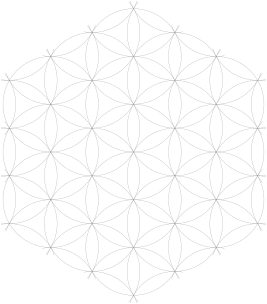
\begin{tikzpicture}[scale=.75]

  \tkzSetUpLine[line width=2pt,color=teal!80!black]

  \tkzSetUpCompass[line width=2pt,color=teal!80!black]

   \tkzDefPoint(0,0){O}  \tkzDefPoint(2.25,0){A}

   \tkzDrawCircle(O,A)

\foreach \i in {0,...,5}{

   \tkzDefPointBy[rotation= center O angle 30+60*\i](A)\tkzGetPoint{a\i}

   \tkzDefPointBy[rotation= center {a\i} angle  120](O)\tkzGetPoint{b\i}

   \tkzDefPointBy[rotation= center {a\i} angle  180](O)\tkzGetPoint{c\i}

   \tkzDefPointBy[rotation= center {c\i} angle  120](a\i)\tkzGetPoint{d\i}

   \tkzDefPointBy[rotation= center {c\i} angle   60](d\i)\tkzGetPoint{f\i}

   \tkzDefPointBy[rotation= center {d\i} angle   60](b\i)\tkzGetPoint{e\i}

   \tkzDefPointBy[rotation= center {f\i} angle   60](d\i)\tkzGetPoint{g\i}

   \tkzDefPointBy[rotation= center {d\i} angle   60](e\i)\tkzGetPoint{h\i}

   \tkzDefPointBy[rotation= center {e\i} angle  180](b\i)\tkzGetPoint{k\i}

   \tkzDrawCircle(a\i,O)

   \tkzDrawCircle(b\i,a\i)

   \tkzDrawCircle(c\i,a\i)

   \tkzDrawArc[rotate](f\i,d\i)(-120)

   \tkzDrawArc[rotate](e\i,d\i)(180)

   \tkzDrawArc[rotate](d\i,f\i)(180)

   \tkzDrawArc[rotate](g\i,f\i)(60)

   \tkzDrawArc[rotate](h\i,d\i)(60)

   \tkzDrawArc[rotate](k\i,e\i)(60)

}

   \tkzClipCircle(O,f0)

\end{tikzpicture}
51.15 Pentagon in a circle

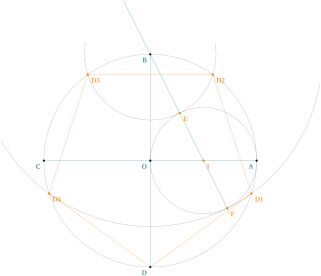
\begin{tikzpicture}[scale=.75]

   \tkzDefPoint(0,0){O}

   \tkzDefPoint(5,0){A}

   \tkzDefPoint(0,5){B}

   \tkzDefPoint(-5,0){C}

   \tkzDefPoint(0,-5){D}

   \tkzDefMidPoint(A,O)             \tkzGetPoint{I}

   \tkzInterLC(I,B)(I,A)            \tkzGetPoints{F}{E}

   \tkzInterCC(O,C)(B,E)            \tkzGetPoints{D3}{D2}

   \tkzInterCC(O,C)(B,F)            \tkzGetPoints{D4}{D1}

   \tkzDrawArc[angles](B,E)(180,360)

   \tkzDrawArc[angles](B,F)(220,340)

   \tkzDrawLine[add=.5 and .5](B,I)

   \tkzDrawCircle(O,A)

   \tkzDefCircle[diameter](O,A)     \tkzGetPoint{x}

   \tkzDrawCircle(x,A)

   \tkzDrawSegments(B,D C,A)

   \tkzDrawPolygon[new](D,D1,D2,D3,D4)

   \tkzDrawPoints(A,...,D,O)

   \tkzDrawPoints[new](E,F,I,D1,D2,D4,D3)

   \tkzLabelPoints[below left](A,...,D,O)

   \tkzLabelPoints[new,below right](I,E,F,D1,D2,D4,D3)

\end{tikzpicture}
51.16 Pentagon in a square

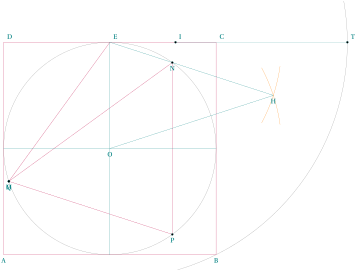
\begin{tikzpicture}[scale=.75]

  \tkzDefPoints{0/0/O,-5/-5/A,5/-5/B}

  \tkzDefSquare(A,B)   \tkzGetPoints{C}{D}

  \tkzDefMidPoint(A,B) \tkzGetPoint{F}

  \tkzDefMidPoint(C,D) \tkzGetPoint{E}

  \tkzDefMidPoint(B,C) \tkzGetPoint{G}

  \tkzDefMidPoint(A,D) \tkzGetPoint{K}

  \tkzInterLC[near](C,D)(E,B)              \tkzGetFirstPoint{T}

  \tkzDefMidPoint(D,T)                     \tkzGetPoint{I}

  \tkzInterCC[with nodes](O,D,I)(E,D,I)    \tkzGetSecondPoint{H}

  \tkzInterLC(O,H)(O,E)                    \tkzGetSecondPoint{M}

  \tkzInterCC(O,E)(E,M)                    \tkzGetFirstPoint{Q}

  \tkzInterCC[with nodes](O,O,E)(Q,E,M)    \tkzGetFirstPoint{P}

  \tkzInterCC[with nodes](O,O,E)(P,E,M)    \tkzGetFirstPoint{N}

  \tkzCompasss(O,H E,H)

  \tkzDrawArc(E,B)(T)

  \tkzDrawPolygons[purple](A,B,C,D M,E,Q,P,N)

  \tkzDrawCircle(O,E)

  \tkzDrawSegments(T,I O,H E,H E,F G,K)

  \tkzDrawPoints(T,M,Q,P,N,I)

  \tkzLabelPoints(A,B,O,N,P,Q,M,H)

  \tkzLabelPoints[above right](C,D,E,I,T)

\end{tikzpicture}
51.17 Inscribed hexagon

51.17.1 Inscribed hexagon: version 1

  \begin{tikzpicture}[scale=.5]

   \pgfmathsetmacro{\c}{6}

   \tkzDefPoints{0/0/A,\c/0/B}

   \tkzDefTriangle[equilateral](A,B)\tkzGetPoint{C}

   \tkzDefTriangleCenter[centroid](A,B,C)

   \tkzGetPoint{I}

   \tkzDefPointBy[homothety=center A ratio 1./3](B)

   \tkzGetPoint{c1}

   \tkzInterLC(B,C)(I,c1) \tkzGetPoints{a1}{a2}

   \tkzInterLC(A,C)(I,c1) \tkzGetPoints{b1}{b2}

   \tkzInterLC(A,B)(I,c1) \tkzGetPoints{c1}{c2}

   \tkzDrawPolygon(A,B,C)

   \tkzDrawCircle[thin,orange](I,c1)

   \tkzDrawPolygon[red,thick](a2,a1,b2,b1,c2,c1)

 \end{tikzpicture}
51.17.2 Inscribed hexagon: version 2
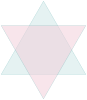
\begin{tikzpicture}[scale=.5]

 \pgfmathsetmacro{\c}{6}

 \tkzDefPoints{0/0/A,\c/0/B}

 \tkzDefTriangle[equilateral](A,B)\tkzGetPoint{C}

 \tkzDefTriangleCenter[centroid](A,B,C)

 \tkzGetPoint{I}

 \tkzDefPointsBy[rotation= center I

                 angle 60](A,B,C){a,b,c}

 \tkzDrawPolygon[fill=teal!20,opacity=.5](A,B,C)

 \tkzDrawPolygon[fill=purple!20,opacity=.5](a,b,c)

\end{tikzpicture}
51.18 Power of a point with respect to a circle

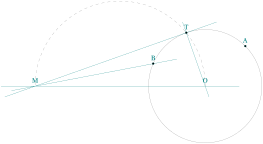
\begin{tikzpicture}

 \pgfmathsetmacro{\r}{2}%

 \pgfmathsetmacro{\xO}{6}%

 \pgfmathsetmacro{\xE}{\xO-\r}%

 \tkzDefPoints{0/0/M,\xO/0/O,\xE/0/E}

 \tkzDefCircle[diameter](M,O)

 \tkzGetPoint{I}

 \tkzInterCC(I,O)(O,E) \tkzGetPoints{T}{T'}

 \tkzDefShiftPoint[O](45:2){B}

 \tkzInterLC(M,B)(O,E) \tkzGetPoints{A}{B}

 \tkzDrawCircle(O,E)

 \tkzDrawSemiCircle[dashed](I,O)

 \tkzDrawLine(M,O)

 \tkzDrawLines(M,T O,T M,B)

 \tkzDrawPoints(A,B,T)

 \tkzLabelPoints[above](A,B,O,M,T)

\end{tikzpicture}
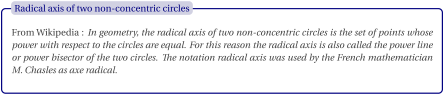
51.19 Radical axis of two non-concentric circles
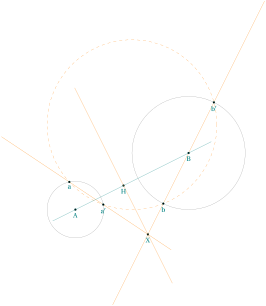
\begin{tikzpicture}

\tkzDefPoints{0/0/A,4/2/B,2/3/K}

\tkzDefCircle[R](A,1)\tkzGetPoint{a}

\tkzDefCircle[R](B,2)\tkzGetPoint{b}

\tkzDefCircle[R](K,3)\tkzGetPoint{k}

\tkzDrawCircles(A,a B,b)

\tkzDrawCircle[dashed,new](K,k)

\tkzInterCC(A,a)(K,k) \tkzGetPoints{a}{a'}

\tkzInterCC(B,b)(K,k) \tkzGetPoints{b}{b'}

\tkzDrawLines[new,add=2 and 2](a,a')

\tkzDrawLines[new,add=1 and 1](b,b')

\tkzInterLL(a,a')(b,b') \tkzGetPoint{X}

\tkzDefPointBy[projection= onto A--B](X) \tkzGetPoint{H}

\tkzDrawPoints(A,B,H,X,a,b,a',b')

\tkzDrawLine(A,B)

\tkzDrawLine[add= 1 and 2,new](X,H)

\tkzLabelPoints(A,B,H,X,a,b,a',b')

\end{tikzpicture}
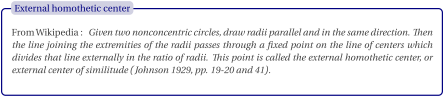
51.20 External homothetic center
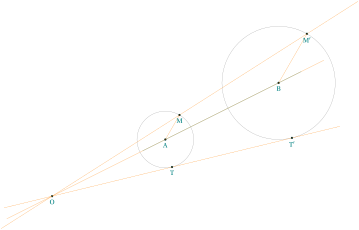
\begin{tikzpicture}

\tkzDefPoints{0/0/A,4/2/B,2/3/K}

\tkzDefCircle[R](A,1)\tkzGetPoint{a}

\tkzDefCircle[R](B,2)\tkzGetPoint{b}

\tkzDrawCircles(A,a B,b)

\tkzDrawLine(A,B)

\tkzDefShiftPoint[A](60:1){M}

\tkzDefShiftPoint[B](60:2){M'}

\tkzInterLL(A,B)(M,M') \tkzGetPoint{O}

\tkzDefLine[tangent from = O](B,M') \tkzGetPoints{X}{T'}

\tkzDefLine[tangent from = O](A,M) \tkzGetPoints{X}{T}

\tkzDrawPoints(A,B,O,T,T',M,M')

\tkzDrawLines[new](O,B O,T' O,M')

\tkzDrawSegments[new](A,M B,M')

\tkzLabelPoints(A,B,O,T,T',M,M')

\end{tikzpicture}
51.21 Tangent lines to two circles

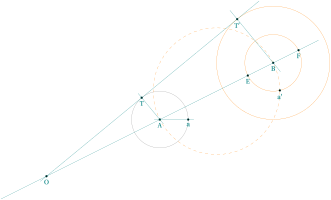
\begin{tikzpicture}

 \pgfmathsetmacro{\r}{1}%

 \pgfmathsetmacro{\R}{2}%

 \pgfmathsetmacro{\rt}{\R-\r}%

 \tkzDefPoints{0/0/A,4/2/B,2/3/K}

 \tkzDefMidPoint(A,B) \tkzGetPoint{I}

 \tkzInterLC[R](A,B)(B,\rt) \tkzGetPoints{E}{F}

 \tkzInterCC(I,B)(B,F) \tkzGetPoints{a}{a'}

 \tkzInterLC[R](B,a)(B,\R) \tkzGetPoints{X'}{T'}

 \tkzDefLine[tangent at=T'](B) \tkzGetPoint{h}

 \tkzInterLL(T',h)(A,B) \tkzGetPoint{O}

 \tkzInterLC[R](O,T')(A,\r) \tkzGetPoints{T}{T}

 \tkzDefCircle[R](A,\r)  \tkzGetPoint{a}

 \tkzDefCircle[R](B,\R)  \tkzGetPoint{b}

 \tkzDefCircle[R](B,\rt)  \tkzGetPoint{c}

 \tkzDrawCircles(A,a)

 \tkzDrawCircles[orange](B,b B,c)

 \tkzDrawCircle[orange,dashed](I,B)

 \tkzDrawPoints(O,A,B,a,a',E,F,T',T)

 \tkzDrawLines(O,B A,a B,T' A,T)

 \tkzDrawLines[add= 1 and 8](T',h)

 \tkzLabelPoints(O,A,B,a,a',E,F,T,T')

\end{tikzpicture}
51.22 Tangent lines to two circles with radical axis
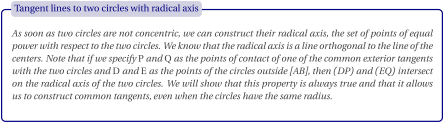

\begin{tikzpicture}

\tkzDefPoints{0/0/A,4/2/B,2/3/K}

\tkzDefCircle[R](A,1) \tkzGetPoint{a}

\tkzDefCircle[R](B,3) \tkzGetPoint{b}

\tkzInterCC[R](A,1)(K,3) \tkzGetPoints{a}{a'}

\tkzInterCC[R](B,3)(K,3) \tkzGetPoints{b}{b'}

\tkzInterLL(a,a')(b,b')  \tkzGetPoint{X}

\tkzDefPointBy[projection= onto A--B](X) \tkzGetPoint{H}

\tkzGetPoint{C}

\tkzInterLC[R](A,B)(B,3) \tkzGetPoints{b1}{E}

\tkzInterLC[R](A,B)(A,1) \tkzGetPoints{D}{a2}

\tkzDefMidPoint(D,E) \tkzGetPoint{I}

\tkzDrawCircle[orange](I,D)

\tkzInterLC(X,H)(I,D) \tkzGetPoints{M}{M'}

\tkzInterLC(M,D)(A,D) \tkzGetPoints{P}{P'}

\tkzInterLC(M,E)(B,E) \tkzGetPoints{Q'}{Q}

\tkzInterLL(P,Q)(A,B) \tkzGetPoint{O}

\tkzDrawCircles(A,a B,b)

\tkzDrawSegments[orange](A,P I,M B,Q)

\tkzDrawPoints(A,B,D,E,M,I,O,P,Q,X,H)

\tkzDrawLines(O,E M,D M,E O,Q)

\tkzDrawLine[add= 3 and 4,orange](X,H)

\tkzLabelPoints(A,B,D,E,M,I,O,P,Q,X,H)

\end{tikzpicture}
51.23 Midpoint of a segment with a compass

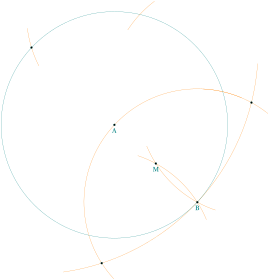
\begin{tikzpicture}

\tkzDefPoint(0,0){A}

\tkzDefRandPointOn[circle= center A radius 4]    \tkzGetPoint{B}

\tkzDefPointBy[rotation= center A angle 180](B)  \tkzGetPoint{C}

\tkzInterCC(A,B)(B,A)                            \tkzGetPoints{I}{I'}

\tkzInterCC(A,I)(I,A)                            \tkzGetPoints{J}{B}

\tkzInterCC(B,A)(C,B)                            \tkzGetPoints{D}{E}

\tkzInterCC(D,B)(E,B)                            \tkzGetPoints{M}{M'}

\tkzSetUpArc[color=orange,style=solid,delta=10]

\tkzDrawArc(C,D)(E)

\tkzDrawArc(B,E)(D)

\tkzDrawCircle[color=teal,line width=.2pt](A,B)

\tkzDrawArc(D,B)(M)

\tkzDrawArc(E,M)(B)

\tkzCompasss[color=orange,style=solid](B,I I,J J,C)

\tkzDrawPoints(A,B,C,D,E,M)

\tkzLabelPoints(A,B,M)

\end{tikzpicture}
51.24 Definition of a circle, _Apollonius_
Explanation
A circle is the set of points of a plane that are equidistant from a given point \(O\). The distance \(r\) from the center is called the radius, and the point \(O\) is called the center. It is the simplest definition but it is not the only one. Apollonius of Perga gives another definition: The set of all points whose distances from two fixed points are in a constant ratio is a circle.
With tkz-euclide it is easy to illustrate the last definition.
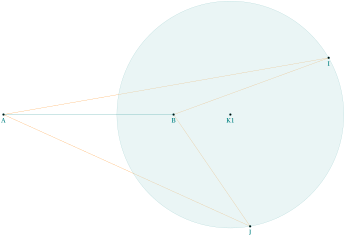
\begin{tikzpicture}[scale=1.5]

    % Firstly we defined two fixed point.

    % The figure depends of these points and the ratio K

\tkzDefPoint(0,0){A}

\tkzDefPoint(4,0){B}

    % tkz-euclide.sty knows about the apollonius's circle

    % with K=2 we search some points like  I such as IA=2 x IB

\tkzDefCircle[apollonius,K=2](A,B) \tkzGetPoints{K1}{k}

\tkzDefPointOnCircle[through=  center K1 angle 30 point k]

\tkzGetPoint{I}

\tkzDefPointOnCircle[through= center K1 angle 280  point k]

\tkzGetPoint{J}

\tkzDrawSegments[new](A,I I,B A,J J,B)

\tkzDrawCircle[color = teal,fill=teal!20,opacity=.4](K1,k)

\tkzDrawPoints(A,B,K1,I,J)

\tkzDrawSegment(A,B)

\tkzLabelPoints[below,font=\scriptsize](A,B,K1,I,J)

\end{tikzpicture}
51.25 Application of Inversion: Pappus chain

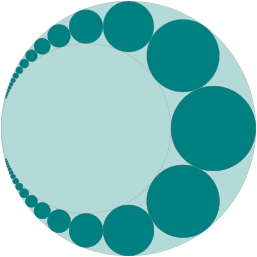
\begin{tikzpicture}[ultra thin]

  \pgfmathsetmacro{\xB}{6}%

  \pgfmathsetmacro{\xC}{9}%

  \pgfmathsetmacro{\xD}{(\xC*\xC)/\xB}%

  \pgfmathsetmacro{\xJ}{(\xC+\xD)/2}%

  \pgfmathsetmacro{\r}{\xD-\xJ}%

  \pgfmathsetmacro{\nc}{16}%

  \tkzDefPoints{0/0/A,\xB/0/B,\xC/0/C,\xD/0/D}

  \tkzDefCircle[diameter](A,C) \tkzGetPoint{x}

  \tkzDrawCircle[fill=teal!30](x,C)

  \tkzDefCircle[diameter](A,B) \tkzGetPoint{y}

  \tkzDrawCircle[fill=teal!30](y,B)

  \foreach \i in {-\nc,...,0,...,\nc}

  {\tkzDefPoint(\xJ,2*\r*\i){J}

   \tkzDefPoint(\xJ,2*\r*\i-\r){H}

   \tkzDefCircleBy[inversion = center A through C](J,H)

   \tkzDrawCircle[fill=teal](tkzFirstPointResult,tkzSecondPointResult)}

\end{tikzpicture}
51.26 Archimedes, Book of Lemmas, Proposition 1

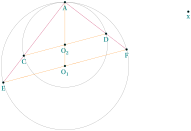
  \begin{tikzpicture}[scale=.75]

    \tkzDefPoints{0/0/O_1,0/1/O_2,0/3/A}

    \tkzDefPoint(15:3){F}

     \tkzDefPointBy[symmetry=center O_1](F) \tkzGetPoint{E}

     \tkzDefLine[parallel=through O_2](E,F) \tkzGetPoint{x}

     \tkzInterLC(x,O_2)(O_2,A) \tkzGetPoints{D}{C}

     \tkzDrawCircles(O_1,A O_2,A)

     \tkzDrawSegments[orange](O_1,A E,F C,D)

     \tkzDrawSegments[purple](A,E A,F)

     \tkzDrawPoints(A,O_1,O_2,E,F,x,C,D)

     \tkzLabelPoints(A,O_1,O_2,E,F,x,C,D)

  \end{tikzpicture}
\((CD) \parallel (EF)\) and \((AO_1)\) intersects these two lines, so \(\widehat{AO_2C} = \widehat{AO_1E}\).
Since the triangles \(AO_2C\) and \(AO_1E\) are isosceles, their base angles are equal: \(\widehat{ACO_2} = \widehat{AEO_1} = \widehat{CAO_2} = \widehat{EAO_1}\). Thus \(A\), \(C\) and \(E\) are aligned.
51.27 Archimedes, Book of Lemmas, Proposition 6

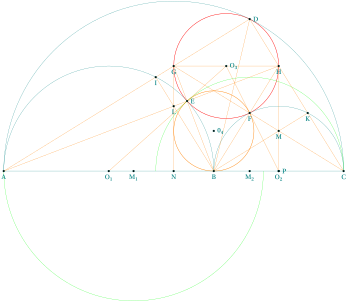
\begin{tikzpicture}

\tkzDefPoints{0/0/A,12/0/C}

\tkzDefGoldenRatio(A,C)                  \tkzGetPoint{B}

\tkzDefMidPoint(A,C)                     \tkzGetPoint{O}

\tkzDefMidPoint(A,B)                     \tkzGetPoint{O_1}

\tkzDefMidPoint(B,C)                     \tkzGetPoint{O_2}

\tkzDefExtSimilitudeCenter(O_1,A)(O_2,B) \tkzGetPoint{M_0}

\tkzDefIntSimilitudeCenter(O,A)(O_1,A)   \tkzGetPoint{M_1}

\tkzDefIntSimilitudeCenter(O,C)(O_2,C)   \tkzGetPoint{M_2}

\tkzInterCC(O_1,A)(M_2,C)                \tkzGetFirstPoint{E}

\tkzInterCC(O_2,C)(M_1,A)                \tkzGetSecondPoint{F}

\tkzInterCC(O,A)(M_0,B)                  \tkzGetFirstPoint{D}

\tkzInterLL(O_1,E)(O_2,F)                \tkzGetPoint{O_3}

\tkzDefCircle[circum](E,F,B)             \tkzGetPoint{0_4}

\tkzInterLC(A,D)(O_1,A)                  \tkzGetFirstPoint{I}

\tkzInterLC(C,D)(O_2,B)                  \tkzGetSecondPoint{K}

\tkzInterLC[common=D](A,D)(O_3,D)        \tkzGetFirstPoint{G}

\tkzInterLC[common=D](C,D)(O_3,D)        \tkzGetFirstPoint{H}

\tkzInterLL(C,G)(B,K)                    \tkzGetPoint{M}

\tkzInterLL(A,H)(B,I)                    \tkzGetPoint{L}

\tkzInterLL(L,G)(A,C)                    \tkzGetPoint{N}

\tkzInterLL(M,H)(A,C)                    \tkzGetPoint{P}

\tkzDrawCircles[red,thin](O_3,F)

\tkzDrawCircles[new,thin](0_4,B)

\tkzDrawSemiCircles[teal](O,C O_1,B O_2,C)

\tkzDrawSemiCircles[green](M_2,C)

\tkzDrawSemiCircles[green,swap](M_1,A)

\tkzDrawSegment(A,C)

\tkzDrawSegments[new](O_1,O_3 O_2,O_3)

\tkzDrawSegments[new,very thin](B,H C,G A,H G,N H,P)

\tkzDrawSegments[new,very thin](B,D A,D C,D G,H I,B K,B B,G)

\tkzDrawPoints(A,B,C,M_1,M_2,E,O_3,F,D,0_4,O_1,O_2,I,K,G,H,L,P,N,M)

\tkzLabelPoints[font=\scriptsize](A,B,C,M_1,M_2,F,O_1,O_2,I,K,G,H,L,M,N)

\tkzLabelPoints[font=\scriptsize,right](E,O_3,D,0_4,P)

\end{tikzpicture}
Let \(GH\) be the diameter of the circle which is parallel to \(AC\), and let the circle touch the semicircles on \(AC\), \(AB\), \(BC\) in \(D\), \(E\), \(F\) respectively.
Then, by Prop. 1, \(A\), \(G\) and \(D\) are aligned, as well as \(D\), \(H\) and \(C\).
For the same reason, \(A\), \(E\) and \(H\) are aligned, \(C\), \(F\) and \(G\) are aligned, and so are \(B\), \(E\), \(G\) and \(B\), \(F\), \(H\).
Let \((AD)\) meet the semicircle on \([AC]\) at \(I\), and let \((BD)\) meet the semicircle on \([BC]\) in \(K\). Join \(CI\) and \(CK\), meeting \(AE\) and \(BF\) in \(L\) and \(M\), and let \(GL\) and \(HM\), extended, meet \(AB\) in \(N\) and \(P\) respectively.
Now, in the triangle \(AGB\), the perpendiculars from \(A\), \(C\) on the opposite sides meet in \(L\). Therefore by the properties of triangles, \((GN)\) is perpendicular to \((AC)\). Similarly \((HP)\) is perpendicular to \((BC)\).
Again, since the angles at \(I\), \(K\), \(D\) are right, \((CK)\) is parallel to \((AD)\), and \((CI)\) to \((BD)\).
Therefore
\[\frac{AB}{BC} = \frac{AL}{LH} = \frac{AN}{NP} \quad\text{and} \quad \frac{BC}{AB} = \frac{CM}{MG} = \frac{PC}{NP} \]
hence
\[ \frac{AN}{NP} = \frac{NP}{PC} \quad\text{so} \quad {NP}^2 = AN \times PC \]
Now suppose that \(B\) divides \([AC]\) in the golden ratio, that is:
\[\phi = \frac{AB}{BC} = \frac{AC}{AB} \quad\text{then} \quad AN = \phi NP \text{and}\quad NP = \phi PC \]
We have
\[ AC = AN + NP + PC\quad \text{either} \quad AB + BC = = AN + NP + PC \quad \text{or} \quad (\phi + 1) BC = AN + NP + PC \]
we get
\[ (\phi + 1) BC = \phi NP + NP + PC =(\phi + 1)NP + PC = \phi(\phi + 1)PC + PC = {\phi}^2 + \phi + 1)PC \]
as
\[ {\phi}^2 = \phi + 1 \quad \text{then} \quad (\phi + 1) BC = 2(\phi + 1) PC \quad\text{i.e.}\quad BC = 2 PC \]
That is, \(p\) is the midpoint of the segment \(BC\).
Part of the proof from https://www.cut-the-knot.org
51.28 "The" circle of Apollonius

Explanation
The purpose of the first examples was to show how simply these propositions can be recreated. With TikZ you need calculations and trigonometry, while with tkz-euclide you only need to build simple objects.
But don’t forget that TikZ is behind tkz-euclide, and far above it: I am only creating an interface between TikZ and the users of my package.
The last example is very complex; it shows everything that can be done with tkz-euclide.
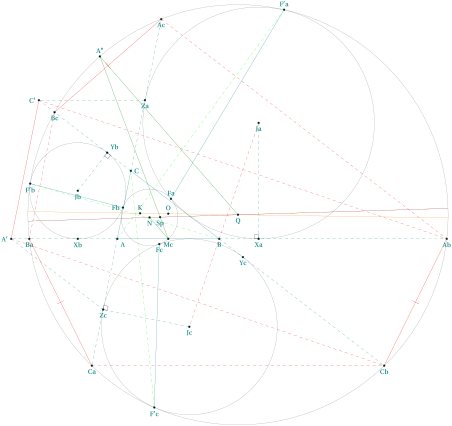
\begin{tikzpicture}[scale=.6]

\tkzDefPoints{0/0/A,6/0/B,0.8/4/C}

\tkzDefTriangleCenter[euler](A,B,C)        \tkzGetPoint{N}

\tkzDefTriangleCenter[circum](A,B,C)       \tkzGetPoint{O}

\tkzDefTriangleCenter[lemoine](A,B,C)      \tkzGetPoint{K}

\tkzDefTriangleCenter[ortho](A,B,C)        \tkzGetPoint{H}

\tkzDefSpcTriangle[excentral,name=J](A,B,C){a,b,c}

\tkzDefSpcTriangle[centroid,name=M](A,B,C){a,b,c}

\tkzDefCircle[in](Ma,Mb,Mc)                \tkzGetPoint{Sp}  % Sp Spieker center

\tkzDefProjExcenter[name=J](A,B,C)(a,b,c){Y,Z,X}

\tkzDefLine[parallel=through Za](A,B)      \tkzGetPoint{Xc}

\tkzInterLL(Za,Xc)(C,B)                    \tkzGetPoint{C'}

\tkzDefLine[parallel=through Zc](B,C)      \tkzGetPoint{Ya}

\tkzInterLL(Zc,Ya)(A,B)                    \tkzGetPoint{A'}

\tkzDefPointBy[reflection= over Ja--Jc](C')\tkzGetPoint{Ab}

\tkzDefPointBy[reflection= over Ja--Jc](A')\tkzGetPoint{Cb}

\tkzInterLL(K,O)(N,Sp)                     \tkzGetPoint{Q}

\tkzInterLC(A,B)(Q,Cb)                     \tkzGetFirstPoint{Ba}

\tkzInterLC(A,C)(Q,Cb)                     \tkzGetPoints{Ac}{Ca}

\tkzInterLC(B,C')(Q,Cb)                    \tkzGetFirstPoint{Bc}

\tkzInterLC[next to=Ja](Ja,Q)(Q,Cb)        \tkzGetFirstPoint{F'a}

\tkzInterLC[next to=Jc](Jc,Q)(Q,Cb)        \tkzGetFirstPoint{F'c}

\tkzInterLC[next to=Jb](Jb,Q)(Q,Cb)        \tkzGetFirstPoint{F'b}

\tkzInterLC[common=F'a](Sp,F'a)(Ja,F'a)    \tkzGetFirstPoint{Fa}

\tkzInterLC[common=F'b](Sp,F'b)(Jb,F'b)    \tkzGetFirstPoint{Fb}

\tkzInterLC[common=F'c](Sp,F'c)(Jc,F'c)    \tkzGetFirstPoint{Fc}

\tkzInterLC(Mc,Sp)(Q,Cb)                   \tkzGetFirstPoint{A''}

\tkzDefCircle[euler](A,B,C)                \tkzGetPoints{E}{e}

\tkzDefCircle[ex](C,A,B)                   \tkzGetPoints{Ea}{a}

\tkzDefCircle[ex](A,B,C)                   \tkzGetPoints{Eb}{b}

\tkzDefCircle[ex](B,C,A)                   \tkzGetPoints{Ec}{c}

% Calculations are done, now you can draw, mark and label

\tkzDrawCircles(Q,Cb E,e)%

\tkzDrawCircles(Eb,b Ea,a Ec,c)

\tkzDrawPolygon(A,B,C)

\tkzDrawSegments[dashed](A,A' C,C' A',Zc Za,C' B,Cb B,Ab A,Ca)

\tkzDrawSegments[dashed](C,Ac Ja,Xa Jb,Yb Jc,Zc)

\begin{scope}

   \tkzClipCircle(Q,Cb) % We limit the drawing of the lines

   \tkzDrawLine[add=5 and 12,orange](K,O)

   \tkzDrawLine[add=12 and 28,red!50!black](N,Sp)

\end{scope}

\tkzDrawPoints(A,B,C,K,Ja,Jb,Jc,Q,N,O,Sp,Mc,Xa,Xb,Yb,Yc,Za,Zc)

\tkzDrawPoints(A',C',A'',Ab,Cb,Bc,Ca,Ac,Ba,Fa,Fb,Fc,F'a,F'b,F'c)

\tkzLabelPoints(Ja,Jb,Jc,Q,Xa,Xb,Za,Zc,Ab,Cb,Bc,Ca,Ac,Ba,F'b)

\tkzLabelPoints[above](O,K,F'a,Fa,A'')

\tkzLabelPoints[below](B,F'c,Yc,N,Sp,Fc,Mc)

\tkzLabelPoints[left](A',C',Fb)

\tkzLabelPoints[right](C)

\tkzLabelPoints[below right](A)

\tkzLabelPoints[above right](Yb)

\tkzDrawSegments(Fc,F'c Fb,F'b Fa,F'a)

\tkzDrawSegments[color=green!50!black](Mc,N Mc,A'' A'',Q)

\tkzDrawSegments[color=red,dashed](Ac,Ab Ca,Cb Ba,Bc Ja,Jc A',Cb C',Ab)

\tkzDrawSegments[color=red](Cb,Ab Bc,Ac Ba,Ca A',C')

\tkzMarkSegments[color=red,mark=|](Cb,Ab Bc,Ac Ba,Ca)

\tkzMarkRightAngles(Jc,Zc,A Ja,Xa,B Jb,Yb,C)

\tkzDrawSegments[green,dashed](A,F'a B,F'b C,F'c)

\end{tikzpicture}