The tcolorbox package
Libraries
18 Library theorems
The library is loaded by a package option or inside the preamble by:
This also loads the package amsmath.
Denis Bitouzé, Yukai Chou, and many others provided very valuable input for this library.
18.1 Macros of the Library
\NewTcbTheorem[⟨init options⟩]{⟨name⟩}{⟨display name⟩}{⟨options⟩}{⟨prefix⟩}Updated: 2022-07-18
\newtcbtheorem[⟨init options⟩]{⟨name⟩}{⟨display name⟩}{⟨options⟩}{⟨prefix⟩}Updated: 2022-07-18
\begin{footheorem}[⟨keys⟩][⟨short⟩]{⟨title⟩}{⟨marker⟩}
⟨environment content⟩
\end{footheorem}¶\begin{footheorem*}[⟨keys⟩]{⟨title⟩}
⟨environment content⟩
\end{footheorem*}
Creates new environments ⟨name⟩ and ⟨name⟩* based on tcolorbox to frame a (mathematical) theorem. The ⟨display name⟩ is used in the title line with a number, e. g. «Theorem 5.1». The ⟨options⟩ are given to the underlying tcolorbox to control the appearance. The ⟨init options⟩ allow setting up automatic numbering, see Section 5.
If ⟨name⟩ is chosen as footheorem, the new environments are described by
Here, ⟨title⟩ is the title text for the theorem and is also set as /tcb/nameref identifier. Optionally, the ⟨short⟩ title used instead as /tcb/nameref identifier and in lists of theorems. ⟨keys⟩ supplement the ⟨options⟩ and may be used only in rare cases. The theorem is automatically labeled with ⟨prefix⟩⟨separator⟩⟨marker⟩ where ⟨separator⟩ is predefined as “:”, see /tcb/label separator.
This represents an unnumbered variant. Again, ⟨title⟩ is the title text for the theorem and ⟨keys⟩ supplement the ⟨options⟩. This variant is not labeled and not listed in lists of theorems.
\NewTcbTheorem and \newtcbtheorem are identical and both rely on \NewTColorBox based on \NewDocumentCommand.
\NewTcbTheorem[counter within=section]{mytheo}{My Theorem}%

  {colback=green!5,colframe=green!35!black,fonttitle=\bfseries}{th}

% usage of `\nameref' needs `nameref' or `hyperref' to be loaded

\begin{mytheo}{This is my title}{theoexample}

  This is the text of the theorem. The counter is automatically assigned and,

  in this example, prefixed with the section number. This theorem is numbered with

  \ref{th:theoexample}, it is given on page~\pageref{th:theoexample},

  and it is titled \flqq\nameref{th:theoexample}\frqq.

\end{mytheo}

% usage of `\nameref' needs `nameref' or `hyperref' to be loaded

\begin{mytheo}[][Concise title]{This my very long theorem title with

    too much words}{theoexample2}

  Here we have a long and a short title. This theorem is numbered with

  \ref{th:theoexample2}, it is given on page~\pageref{th:theoexample2},

  and it is titled \flqq\nameref{th:theoexample2}\frqq.

\end{mytheo}

\begin{mytheo}[label=myownlabel]{This is my title}{}

  The label parameter can be left empty without \LaTeX\ error.

  Or you may use an own label to reference Theorem \ref{myownlabel}.

\end{mytheo}

\begin{mytheo}{}{}

  The title can also be left empty without problem. Note that the \enquote{:}

  vanished magically.

\end{mytheo}

\begin{mytheo*}{Unnumbered Theorem}

  This theorem is not numbered.

\end{mytheo*}

\begin{mytheo*}{}

  This theorem has no number and no title.

\end{mytheo*}
To switch off the nameref feature permanently, add nameref/.style={} inside the ⟨options⟩ list.
\RenewTcbTheorem[⟨init options⟩]{⟨name⟩}{⟨display name⟩}{⟨options⟩}{⟨prefix⟩}Updated: 2022-07-18
\renewtcbtheorem[⟨init options⟩]{⟨name⟩}{⟨display name⟩}{⟨options⟩}{⟨prefix⟩}Updated: 2022-07-18
Operates like \NewTcbTheorem, but based on \RenewDocumentEnvironment instead of \NewDocumentEnvironment. Existing environments are redefined.
\ProvideTcbTheorem[⟨init options⟩]{⟨name⟩}{⟨display name⟩}{⟨options⟩}{⟨prefix⟩}New: 2022-07-18
Operates like \NewTcbTheorem, but based on \ProvideDocumentEnvironment instead of \NewDocumentEnvironment. New environments are only created if they are not already defined.
\DeclareTcbTheorem[⟨init options⟩]{⟨name⟩}{⟨display name⟩}{⟨options⟩}{⟨prefix⟩}New: 2022-07-18
Operates like \NewTcbTheorem, but based on \DeclareDocumentEnvironment instead of \NewDocumentEnvironment. New environments are always created and possibly redefine existing ones.
\tcboxmath[⟨options⟩]{⟨mathematical box content⟩}
Creates a tcolorbox which is fitted to the width of the given ⟨mathematical box content⟩. This box is intended to be applied as part of a larger formula and may be used as replacement for the \boxed macro of amsmath.

\begin{equation}

\tcbset{fonttitle=\scriptsize}

\tcboxmath[colback=LightBlue!25!white,colframe=blue]{ a^2 = 16 }

\quad \Rightarrow \quad

\tcboxmath[colback=Salmon!25!white,colframe=red,title=Implication]%

  { a = 4 ~\vee~ a=-4. }

\end{equation}
\tcbhighmath[⟨options⟩]{⟨mathematical box content⟩}
This is a special case of the \tcboxmath macro which uses the style /tcb/highlight math. It is intended to provide context sensitive highlighting of formula parts. The color settings via /tcb/highlight math style may be different inside theorems or other colored areas and outside.
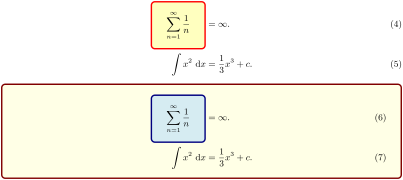
\tcbset{myformula/.style={colback=yellow!10!white,colframe=red!50!black,

  every box/.style={highlight math style={colback=LightBlue!50!white,colframe=Navy}}

  }}


\begin{align}

  \tcbhighmath{\sum\limits_{n=1}^{\infty} \frac{1}{n}} &= \infty.\\

  \int x^2 ~\text{d}x                     &= \frac13 x^3 + c.

\end{align}


\begin{tcolorbox}[ams align,myformula]

  \tcbhighmath{\sum\limits_{n=1}^{\infty} \frac{1}{n}} &= \infty.\\

  \int x^2 ~\text{d}x                     &= \frac13 x^3 + c.

\end{tcolorbox}
\tcbhighmath can be used in symbiosis with the empheq package which allows to specify own boxing commands to mark multiline formulas.
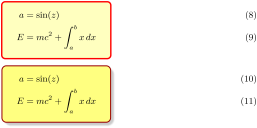
% \usepackage{empheq}

\begin{empheq}[box=\tcbhighmath]{align}

a&=\sin(z)\\

E&=mc^2 + \int_a^b x\, dx

\end{empheq}


\tcbset{highlight math style={enhanced,

  colframe=red!60!black,colback=yellow!50!white,arc=4pt,boxrule=1pt,

  drop fuzzy shadow}}


\begin{empheq}[box=\tcbhighmath]{align}

a&=\sin(z)\\

E&=mc^2 + \int_a^b x\, dx

\end{empheq}
Besides \tcbhighmath, one can easily define an independent new box based on \tcbox which acts like \tcbhighmath:
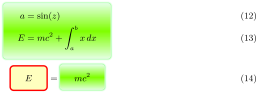
% \usepackage{empheq}

\newtcbox{\otherbox}[1][]{nobeforeafter,math upper,tcbox raise base,

  enhanced,frame hidden,boxrule=0pt,interior style={top color=green!10!white,

  bottom color=green!10!white,middle color=green!50!yellow},

  fuzzy halo=1pt with green,#1}


\begin{empheq}[box=\otherbox]{align}

a&=\sin(z)\\

E&=mc^2 + \int_a^b x\, dx

\end{empheq}


\begin{equation}

\tcbhighmath{E} = \otherbox{mc^2}

\end{equation}
18.2 Option Keys of the Library
/tcb/separator sign=⟨sign⟩(no default, initially :)
The given ⟨sign⟩ is used inside the title text of a theorem as separator between display name combined with number and the specific title text. It is omitted, if there is no specific title text.

% \usepackage{amssymb}

\newtcbtheorem[use counter from=mytheo]{sometheorem}{Theorem}%

  {colback=white,colframe=red!50!black,fonttitle=\bfseries,

   separator sign={\ $\blacktriangleright$}}{theo}

\begin{sometheorem}{My example}{}

My theorem text.

\end{sometheorem}
/tcb/separator sign colon(style, no value, initially set)
Sets /tcb/separator sign to the default colon : sign.
/tcb/separator sign dash(style, no value)
Sets /tcb/separator sign to an en-dash sign.

\newtcbtheorem[use counter from=mytheo]{sometheorem}{Theorem}%

  {colback=white,colframe=red!50!black,fonttitle=\bfseries,

   separator sign dash}{theo}

\begin{sometheorem}{My example}{}

My theorem text.

\end{sometheorem}
/tcb/separator sign none(style, no value)
Sets /tcb/separator sign to empty.

\newtcbtheorem[use counter from=mytheo]{sometheorem}{Theorem}%

  {colback=white,colframe=red!50!black,fonttitle=\bfseries,

   separator sign none}{theo}

\begin{sometheorem}{My example}{}

My theorem text.

\end{sometheorem}
/tcb/description delimiters={⟨left⟩}{⟨right⟩}(no default, initially empty)
The given ⟨left⟩ and ⟨right⟩ delimiter signs are used to frame the descriptive title text of a theorem.

\newtcbtheorem[use counter from=mytheo]{sometheorem}{Theorem}%

  {colback=white,colframe=red!50!black,fonttitle=\bfseries,

   description delimiters={\flqq}{\frqq}}{theo}

\begin{sometheorem}{My example}{}

My theorem text.

\end{sometheorem}
/tcb/description delimiters parenthesis(style, no value)
Sets /tcb/description delimiters to ( and ).

\newtcbtheorem[use counter from=mytheo]{sometheorem}{Theorem}%

  {colback=white,colframe=red!50!black,fonttitle=\bfseries,

   description delimiters parenthesis}{theo}

\begin{sometheorem}{My example}{}

My theorem text.

\end{sometheorem}
/tcb/description delimiters none(style, no value, initially set)
Sets /tcb/description delimiters to the default empty texts.
/tcb/description color=⟨color⟩(default empty, initially empty)
Sets the ⟨color⟩ of the descriptive title text deviating from /tcb/coltitle. The color is reset to /tcb/coltitle, if description color is used without value.

\newtcbtheorem[use counter from=mytheo]{sometheorem}{Theorem}%

  {colback=white,colframe=red!50!black,fonttitle=\bfseries,

   description color=red!25!yellow}{theo}

\begin{sometheorem}{My example}{}

My theorem text.

\end{sometheorem}
/tcb/description font=⟨text⟩(default empty, initially empty)
Sets ⟨text⟩ (e. g. font settings) before the descriptive title text deviating from /tcb/fonttitle. The ⟨text⟩ is removed, if description font is used without value.

\newtcbtheorem[use counter from=mytheo]{sometheorem}{Theorem}%

  {colback=white,colframe=red!50!black,fonttitle=\bfseries,

   description delimiters={\glqq}{\grqq},

   description font=\mdseries\itshape}{theo}

\begin{sometheorem}{My example}{}

My theorem text.

\end{sometheorem}
/tcb/description formatter=⟨macro⟩(default empty, initially empty)
Sets ⟨macro⟩ as formatter for the descriptive title text. The ⟨macro⟩ has to take one mandatory argument (the description text).
Note that /tcb/description delimiters, /tcb/description color, and /tcb/description font are ignored, if this option is used.
If description formatter is used without value, the formatter is reset to its standard behavior.

\newtcbox{\formbox}{enhanced,frame empty,size=minimal,boxsep=2pt,arc=1pt,

  on line,interior style image=goldshade.png}


\newtcbtheorem[use counter from=mytheo]{sometheorem}{Theorem}%

  {colback=white,colframe=red!50!black,fonttitle=\bfseries,

   description formatter=\formbox}{theo}

\begin{sometheorem}{My example}{}

My theorem text.

\end{sometheorem}
/tcb/terminator sign=⟨sign⟩(no default, initially empty)
The given ⟨sign⟩ is used as terminator at the end of the title text of a theorem.

\newtcbtheorem[use counter from=mytheo]{sometheorem}{Theorem}%

  {colback=white,colframe=red!50!black,fonttitle=\bfseries,

   terminator sign={.}}{theo}

\begin{sometheorem}{My example}{}

My theorem text.

\end{sometheorem}
/tcb/terminator sign colon(style, no value, initially set)
Sets /tcb/terminator sign to the colon : sign.

\newtcbtheorem[use counter from=mytheo]{sometheorem}{Theorem}%

  {colback=white,colframe=red!50!black,fonttitle=\bfseries,

   separator sign dash,terminator sign colon}{theo}

\begin{sometheorem}{My example}{}

My theorem text.

\end{sometheorem}
/tcb/terminator sign dash(style, no value)
Sets /tcb/terminator sign to an en-dash sign.

\newtcbtheorem[use counter from=mytheo]{sometheorem}{Theorem}%

  {colback=white,colframe=red!50!black,fonttitle=\bfseries,

   terminator sign dash}{theo}

\begin{sometheorem}{My example}{}

My theorem text.

\end{sometheorem}
/tcb/terminator sign none(style, no value)
Sets /tcb/terminator sign to the default empty text.
/tcb/label separator=⟨separator⟩(no default, initially :)New: 2016-04-19
The given ⟨separator⟩ is used for labels created with environments which are defined themselves by \newtcbtheorem. This ⟨separator⟩ is put between ⟨prefix⟩ (defined by \newtcbtheorem) and ⟨marker⟩ (defined by an actual theorem environment).

\newtcbtheorem[use counter from=mytheo]{sometheorem}{Theorem}%

  {colback=white,colframe=red!50!black,fonttitle=\bfseries,

   label separator=*}{theo}

\begin{sometheorem}{My example}{myex}

My theorem text.

\end{sometheorem}

See Example~\ref{theo*myex}.
/tcb/theorem full label supplement={⟨style⟩}(no default, initially empty)New: 2018-01-12
The given ⟨style⟩ is used in connection with labels created with environments which are defined themselves by \newtcbtheorem. This ⟨style⟩ uses one argument which is automatically set to the full label marker of the environment, i. e., a text consisting of ⟨prefix⟩ (defined by \newtcbtheorem), /tcb/label separator, and ⟨marker⟩ (defined by an actual theorem environment).

% The following adds a hyper target to all environments

% created with \newtcbtheorem

\tcbset{theorem full label supplement={hypertarget={#1}}}


\newtcbtheorem[use counter from=mytheo]{sometheorem}{Theorem}%

   {colback=white,colframe=red!50!black,fonttitle=\bfseries}{theo}

\begin{sometheorem}{My example}{myex2}

My theorem text.

\end{sometheorem}

This automated \hyperlink{theo:myex2}{hyper target can be linked to with a

 hyper link}.
A second usage of /tcb/theorem full label supplement overwrites the first setting.
/tcb/theorem label supplement={⟨style⟩}(no default, initially empty)New: 2018-01-12
The given ⟨style⟩ is used in connection with labels created with environments which are defined themselves by \newtcbtheorem. This ⟨style⟩ uses one argument which is automatically set to the label ⟨marker⟩ defined by an actual theorem environment. A second usage of /tcb/theorem label supplement overwrites the first setting, but /tcb/theorem full label supplement and /tcb/theorem label supplement can be used independently.

% `marginnote' has to be loaded

\newtcbtheorem[use counter from=mytheo]{sometheorem}{Theorem}%

   {colback=white,colframe=red!50!black,fonttitle=\bfseries,

    theorem label supplement={hypertarget={XYZ-##1}},

    theorem full label supplement={code={\marginnote{##1}}}

   }{theo}

\begin{sometheorem}{My example}{myex3}

My theorem text.

\end{sometheorem}

This automated \hyperlink{XYZ-myex3}{hyper target can be linked to with a

 hyper link}.
/tcb/theorem hanging indent=auto|⟨length⟩(default auto, initially auto)New: 2020-10-21
Sets the hanging indent of the theorem title to auto or the given ⟨length⟩. For auto, the hanging indent matches the display name, number and separator sign of the theorem. If ⟨length⟩ is negative, the theorem title is indented positively without hanging indent.
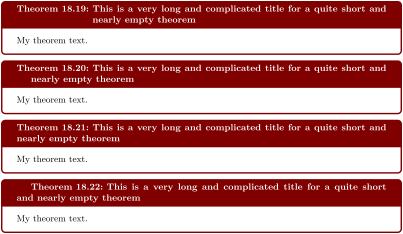
\newtcbtheorem[use counter from=mytheo]{sometheorem}{Theorem}%

  {colback=white,colframe=red!50!black,fonttitle=\bfseries}{theo}


\begin{sometheorem}{This is a very long and complicated title for a quite

  short and nearly empty theorem}{myexA1}

My theorem text.

\end{sometheorem}


\begin{sometheorem}[theorem hanging indent=5mm]{This is a very long and

  complicated title for a quite short and nearly empty theorem}{myexA2}

My theorem text.

\end{sometheorem}


\begin{sometheorem}[theorem hanging indent=0pt]{This is a very long and

  complicated title for a quite short and nearly empty theorem}{myexA3}

My theorem text.

\end{sometheorem}


\begin{sometheorem}[theorem hanging indent=-5mm]{This is a very long and

  complicated title for a quite short and nearly empty theorem}{myexA4}

My theorem text.

\end{sometheorem}
/tcb/theorem name and number(style, no value, initially set)
Prints theorem name followed by theorem number inside the title.

\newtcbtheorem[use counter from=mytheo]{sometheorem}{Theorem}%

  {colback=white,colframe=red!50!black,fonttitle=\bfseries,

   theorem name and number}{theo}

\begin{sometheorem}{My example}{}

My theorem text.

\end{sometheorem}
/tcb/theorem number and name(style, no value)
Prints theorem number followed by theorem name inside the title.

\newtcbtheorem[use counter from=mytheo]{sometheorem}{Theorem}%

  {colback=white,colframe=red!50!black,fonttitle=\bfseries,

   theorem number and name}{theo}

\begin{sometheorem}{My example}{}

My theorem text.

\end{sometheorem}
/tcb/theorem name(style, no value)
Prints theorem name without number inside the title.

\newtcbtheorem[use counter from=mytheo]{sometheorem}{Theorem}%

  {enhanced,colback=white,colframe=red!50!black,fonttitle=\bfseries,

   theorem name,watermark text={\thetcbcounter}}{theo}

\begin{sometheorem}{My example}{}

My theorem text.

\end{sometheorem}
/tcb/theorem number(style, no value)New: 2021-12-03
Prints theorem number without name inside the title.

\newtcbtheorem[use counter from=mytheo]{sometheorem}{Theorem}%

  {enhanced,colback=white,colframe=red!50!black,fonttitle=\bfseries,

   theorem number}{theo}

\begin{sometheorem}{My example}{}

My theorem text.

\end{sometheorem}
/tcb/theorem={⟨display name⟩}{⟨counter⟩}{⟨title⟩}{⟨marker⟩}(no default)
This key can be used directly in a tcolorbox for a more flexible approach to create a theorem type box. The ⟨display name⟩ is used together with the increased ⟨counter⟩ value and the ⟨title⟩ for the title line of the box. Additionally, a \label with the given ⟨marker⟩ is created.

For a common appearance inside the document, the key theorem should not be used directly as in the example above, but as part of a new environment created by hand or using \newtcbtheorem.
/tcb/highlight math(style, no value)
A style which is used for \tcbhighmath and which is predefined as notitle,nophantom,colframe=red,colback=yellow!25!white. It can be changed with the usual pgf key techniques or with /tcb/highlight math style.

\begin{align*}

  \tcbhighmath{1} + 1 &= 2,\\

  \tcbset{highlight math/.append style={left=0mm,right=0mm,top=0mm,bottom=0mm}}

  \tcbhighmath{1} + 1 &= 2.

\end{align*}
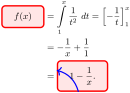
/tcb/highlight math style=⟨style definition⟩(style, no default)
Changes the definition for /tcb/highlight math to notitle,nophantom plus the given ⟨style definition⟩. See \tcbhighmath for another example.
% \tcbuselibrary{skins}

\tcbset{highlight math style={enhanced,%<-- needed for the `remember' options

  colframe=red,colback=red!10!white,boxsep=0pt}}

\begin{align*}

\tcbhighmath[remember as=fx]{f(x)}

     &= \int\limits_{1}^{x} \frac{1}{t^2}~dt

      = \left[ -\frac{1}{t} \right]_{1}^{x}\\

     &= -\frac{1}{x} + \frac{1}{1}\\

     &=

\tcbhighmath[remember,overlay={%

    \draw[blue,very thick,->] (fx.south) to[bend right] ([yshift=2mm]frame.west);}]

  {1-\frac{1}{x}.}

\end{align*}
/tcb/math upper(style, no value)
Sets the upper part to mathematical mode with font \displaystyle.
/tcb/math lower(style, no value)
Sets the lower part to mathematical mode with font \displaystyle.
/tcb/math(style, no value)
Sets the upper part and lower part to mathematical mode with font \displaystyle.

The following styles are only tested to work with the original amsmath environments. If e. g. the equation environment is redefined as gather, then /tcb/ams equation should / could not be used. Obviously, you are encouraged to use /tcb/ams gather in this case.
/tcb/ams equation upper(style, no value)Updated: 2014-10-30
Adds an amsmath equation environment to the start and end of the upper part.
/tcb/ams equation lower(style, no value)Updated: 2014-10-30
Adds an amsmath equation environment to the start and end of the lower part.

/tcb/ams equation* upper(style, no value)Updated: 2014-10-30
Adds an amsmath equation* environment to the start and end of the upper part.
/tcb/ams equation* lower(style, no value)Updated: 2014-10-30
Adds an amsmath equation* environment to the start and end of the lower part.
/tcb/ams equation*(style, no value)Updated: 2014-10-30
Adds an amsmath equation* environment to the start and end of the upper and lower part.

/tcb/ams align(style, no value)Updated: 2024-06-27
/tcb/ams align upper(style, no value)
Adds an amsmath align environment to the start and end of the upper part.

Boxes with /tcb/ams align upper or /tcb/ams align cannot have a lower part! For a lower part, use /tcb/ams nodisplayskip upper instead.
/tcb/ams align lower(style, no value)
Adds an amsmath align environment to the start and end of the lower part.
/tcb/ams align*(style, no value)Updated: 2024-06-27
/tcb/ams align* upper(style, no value)
Adds an amsmath align* environment to the start and end of the upper part.

Boxes with /tcb/ams align* upper or /tcb/ams align* cannot have a lower part! For a lower part, use /tcb/ams nodisplayskip upper instead.
/tcb/ams align* lower(style, no value)
Adds an amsmath align* environment to the start and end of the lower part.
/tcb/ams gather(style, no value)Updated: 2024-06-27
/tcb/ams gather upper(style, no value)
Adds an amsmath gather environment to the start and end of the upper part.

\begin{tcolorbox}[ams gather,colback=yellow!10!white,colframe=red!50!black]

  \sum\limits_{n=1}^{\infty} \frac{1}{n} = \infty.\\

  \int x^2 ~\text{d}x = \frac13 x^3 + c.

\end{tcolorbox}
Boxes with /tcb/ams gather upper or /tcb/ams gather cannot have a lower part! For a lower part, use /tcb/ams nodisplayskip upper instead.
/tcb/ams gather lower(style, no value)
Adds an amsmath gather environment to the start and end of the lower part.
/tcb/ams gather*(style, no value)Updated: 2024-06-27
/tcb/ams gather* upper(style, no value)
Adds an amsmath gather* environment to the start and end of the upper part.

Boxes with /tcb/ams gather* upper or /tcb/ams gather* cannot have a lower part! For a lower part, use /tcb/ams nodisplayskip upper instead.
/tcb/ams gather* lower(style, no value)
Adds an amsmath gather* environment to the start and end of the lower part.
/tcb/ams subequations upper(style, no value)New: 2026-05-04
Adds an amsmath subequations environment to the start and end of the upper part.
/tcb/ams subequations lower(style, no value)New: 2026-05-04
Adds an amsmath subequations environment to the start and end of the lower part.
/tcb/ams subequations(style, no value)New: 2026-05-04
Adds an amsmath subequations environment to the start and end of the upper and lower part.

\begin{tcolorbox}[ams subequations,colback=yellow!10!white,colframe=red!50!black]

  \begin{align}

  \sum\limits_{n=1}^{\infty} \frac{1}{n} &= \infty.\\

  \int x^2 ~\text{d}x                    &= \frac13 x^3 + c.

  \end{align}

\end{tcolorbox}
/tcb/ams subequations align(style, no value)New: 2026-05-04
/tcb/ams subequations align upper(style, no value)
Adds an amsmath subequations and an align environment to the start and end of the upper part.

\begin{tcolorbox}[ams subequations align,

    colback=yellow!10!white,colframe=red!50!black]

  \sum\limits_{n=1}^{\infty} \frac{1}{n} &= \infty.\\

  \int x^2 ~\text{d}x                    &= \frac13 x^3 + c.

\end{tcolorbox}
Boxes with /tcb/ams subequations align upper or /tcb/ams subequations align cannot have a lower part! For a lower part, use /tcb/ams nodisplayskip upper instead.
/tcb/ams subequations align lower(style, no value)
Adds an amsmath subequations and an align environment to the start and end of the lower part.
/tcb/ams subequations gather(style, no value)New: 2026-05-04
/tcb/ams subequations gather upper(style, no value)
Adds an amsmath subequations and a gather environment to the start and end of the upper part.

\begin{tcolorbox}[ams subequations gather,

    colback=yellow!10!white,colframe=red!50!black]

  \sum\limits_{n=1}^{\infty} \frac{1}{n} = \infty.\\

  \int x^2 ~\text{d}x                    = \frac13 x^3 + c.

\end{tcolorbox}
Boxes with /tcb/ams subequations gather upper or /tcb/ams subequations gather cannot have a lower part! For a lower part, use /tcb/ams nodisplayskip upper instead.
/tcb/ams subequations gather lower(style, no value)
Adds an amsmath subequations and a gather environment to the start and end of the lower part.
/tcb/ams nodisplayskip upper(style, no value)
Neutralizes the \abovedisplayskip of a following align or gather environment for the upper part. Note that the text content has to start with such a formula.
/tcb/ams nodisplayskip lower(style, no value)
Neutralizes the \abovedisplayskip of a following align or gather environment for the lower part. Note that the text content has to start with such a formula.
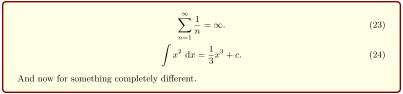
/tcb/ams nodisplayskip(style, no value)
Neutralizes the \abovedisplayskip of a following align or gather environment for the upper part and lower part. Note that the text content has to start with such a formula.
\begin{tcolorbox}[ams nodisplayskip,colback=yellow!10!white,colframe=red!50!black]

  \begin{gather}

  \sum\limits_{n=1}^{\infty} \frac{1}{n} = \infty.\\

  \int x^2 ~\text{d}x = \frac13 x^3 + c.

  \end{gather}

  And now for something completely different.

\end{tcolorbox}
New colored mathematical environments are easily created using \newtcolorbox:

\newtcolorbox{mymath}{ams gather*,colback=yellow!10!white,colframe=red!50!black}


\begin{mymath}

  \sum\limits_{n=1}^{\infty} \frac{1}{n} = \infty.\\

  \int x^2 ~\text{d}x = \frac13 x^3 + c.

\end{mymath}
All described options like /tcb/ams gather upper, /tcb/ams gather lower, /tcb/ams gather are (partially) setting (overwriting) the keys /tcb/before upper, /tcb/after upper, /tcb/before lower, /tcb/after lower. Therefore, e. g. \tcbset{ams gather,before upper={\text{Pythagoras:}}} produces an invalid result. For this case, you are invited to use
\tcbset{ams gather,before upper app={\text{Pythagoras:}}},
see /tcb/before upper app.
/tcb/theorem style=⟨name⟩(no default, initially standard)
standard: This is the initial value.

\begin{theorem}[theorem style=standard]{standard}{}
This is my theorem. \begin{equation*} a^2 + b^2 = c^2. \end{equation*}
\end{theorem}change standard

\begin{theorem}[theorem style=change standard]{change standard}{}
This is my theorem. \begin{equation*} a^2 + b^2 = c^2. \end{equation*}
\end{theorem}plain

\begin{theorem}[theorem style=plain]{plain}{}
This is my theorem. \begin{equation*} a^2 + b^2 = c^2. \end{equation*}
\end{theorem}break

\begin{theorem}[theorem style=break]{break}{}
This is my theorem. \begin{equation*} a^2 + b^2 = c^2. \end{equation*}
\end{theorem}plain apart

\begin{theorem}[theorem style=plain apart]{plain apart}{}
This is my theorem. \begin{equation*} a^2 + b^2 = c^2. \end{equation*}
\end{theorem}change

\begin{theorem}[theorem style=change]{change}{}
This is my theorem. \begin{equation*} a^2 + b^2 = c^2. \end{equation*}
\end{theorem}change break

\begin{theorem}[theorem style=change break]{change break}{}
This is my theorem. \begin{equation*} a^2 + b^2 = c^2. \end{equation*}
\end{theorem}change apart

\begin{theorem}[theorem style=change apart]{change apart}{}
This is my theorem. \begin{equation*} a^2 + b^2 = c^2. \end{equation*}
\end{theorem}margin
\begin{theorem}[theorem style=margin,left=10mm]{margin}{}
This is my theorem. \begin{equation*} a^2 + b^2 = c^2. \end{equation*}
\end{theorem}
\begin{theorem}[theorem style=margin,left=10mm,oversize]{margin}{}
This is my theorem. \begin{equation*} a^2 + b^2 = c^2. \end{equation*}
\end{theorem}margin break
\begin{theorem}[theorem style=margin break,left=10mm]{margin break}{}
This is my theorem. \begin{equation*} a^2 + b^2 = c^2. \end{equation*}
\end{theorem}
\begin{theorem}[theorem style=margin break,left=10mm,oversize]{margin break}{}
This is my theorem. \begin{equation*} a^2 + b^2 = c^2. \end{equation*}
\end{theorem}margin apart
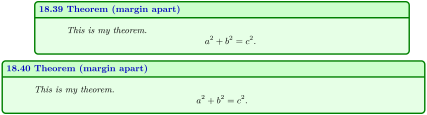
\begin{theorem}[theorem style=margin apart,left=10mm]{margin apart}{}
This is my theorem. \begin{equation*} a^2 + b^2 = c^2. \end{equation*}
\end{theorem}
\begin{theorem}[theorem style=margin apart,left=10mm,oversize]{margin apart}{}
This is my theorem. \begin{equation*} a^2 + b^2 = c^2. \end{equation*}
\end{theorem}
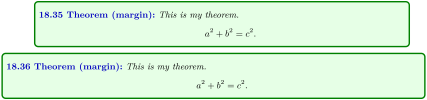
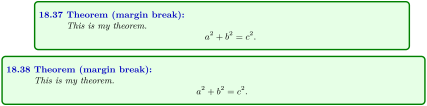
Applies a predefined style ⟨name⟩ to the theorem environment. Some of the feasible ⟨name⟩ values resemble style names from the packages theorem and ntheorem to give convenient access to known patterns.
The styles alter /tcb/separator sign, /tcb/description delimiters, /tcb/terminator sign, and more. Therefore, one should apply such keys after a theorem style.
For the following examples, we use:
\NewTcbTheorem[use counter from=mytheo]{theorem}{Theorem}{%

  fonttitle=\bfseries\upshape,fontupper=\itshape,

  colframe=green!50!black,colback=green!10!white,

  colbacktitle=green!20!white,coltitle=blue!75!black}{theo}
The predefined styles are:
18.3 Examples for Definitions and Theorems
In the following, the application of \newtcbtheorem to highlight mathematical definitions, theorems, or the like is demonstrated.
At first, additional tcb keys are created for the appearance of the colored boxes. It is assumed that theorems and corollaries should be identically colored. All following environments are numbered with a common counter, but this can be changed easily. Here, the counter output is supplemented by the subsection number. Further, the zref-clever package [Barros 2024] is used for clever references.
% \usepackage{zref-clever}

\tcbset{

  defstyle/.style={fonttitle=\bfseries\upshape, fontupper=\slshape,

              arc=0mm, colback=blue!5!white,colframe=blue!75!black},

  theostyle/.style={fonttitle=\bfseries\upshape, fontupper=\slshape,

               colback=red!10!white,colframe=red!75!black},

}

\NewTcbTheorem[counter within=subsection]{Definition}{Definition}%

  {defstyle,label type=definition}{def}

\NewTcbTheorem[use counter from=Definition]{Theorem}{Theorem}%

  {theostyle,label type=theorem}{theo}

\NewTcbTheorem[use counter from=Definition]{Corollary}{Corollary}%

  {theostyle,label type=corollary}{cor}
By \newtcbtheorem, commonly numbered theorem environments are created now. defstyle and theostyle are used for the appearance.
If you do not need zref-clever support, drop /tcb/label type from the definitions above.
Now, everything is prepared for the following examples.

The following theorem is numbered as \zcref[S]{theo:diffbarstetig}

and referenced with the marker \texttt{theo:diffbarstetig}.

Alternatively, use the basic form Theorem~\ref{theo:diffbarstetig}.


\begin{Theorem}{Differenzierbarkeit bedingt Stetigkeit, wobei diese Benennung

  zu Testzwecken ungew\"{o}hnlich lang ist}{diffbarstetig}%

  Eine Funktion $f:I\to\mathbb{R}$ ist in $x_0\in I$ stetig, wenn $f$ in

  $x_0$ differenzierbar ist.

\end{Theorem}
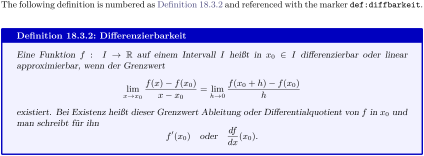
The following definition is numbered as \zcref[cap]{def:diffbarkeit} and

referenced with the marker \texttt{def:diffbarkeit}.\bigskip


\begin{Definition}{Differenzierbarkeit}{diffbarkeit}

  Eine Funktion $f:~I\to\mathbb{R}$ auf einem Intervall $I$ hei\ss{}t in

  $x_0\in I$ differenzierbar oder linear approximierbar,

  wenn der Grenzwert

  \begin{equation*}

  \lim\limits_{x\to x_0}\frac{f(x)-f(x_0)}{x-x_0}=

  \lim\limits_{h\to 0}\frac{f(x_0+h)-f(x_0)}{h}

  \end{equation*}

  existiert. Bei Existenz hei\ss{}t dieser Grenzwert Ableitung

  oder Differentialquotient von $f$ in $x_0$ und man

  schreibt f\"{u}r ihn

  \begin{equation*}

  f'(x_0)\quad\text{oder}\quad\frac{df}{dx}(x_0).

  \end{equation*}

\end{Definition}

The following corollary is numbered as \zcref{cor:nullstellen} and

referenced with the marker \texttt{cor:nullstellen}.\bigskip


\begin{Corollary}{Nullstellenexistenz}{nullstellen}

  Ist $f:[a,b]\to\mathbb{R}$ stetig und haben $f(a)$ und $f(b)$ entgegengesetzte

  Vorzeichen, also $f(a)f(b)<0$, so besitzt $f$ eine Nullstelle $x_0\in]a,b[$,

  also $f(x_0)=0$.

\end{Corollary}

\begin{Theorem}[boxrule=2mm,toptitle=-1.5mm,bottomtitle=-1.5mm]{%

    Hinreichende Bedingung f\"{u}r Wendepunkte}{wendehinreichend}%

  $f$ sei eine auf einem Intervall $]a,b[$ dreimal stetig differenzierbare Funktion.

  Ist $f''(x_0)=0$ in $x_0\in]a,b[$ und $f'''(x_0)\ne 0$, so ist

  $(x_0,f(x_0))$ ein Wendepunkt von $f$.

\end{Theorem}
% \usepackage{zref-clever}

% \usepackage{zref-vario}

% \tcbuselibrary{skins}

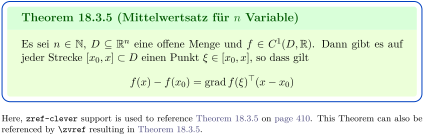
\newtcbtheorem[use counter from=Definition]{YetAnotherTheorem}{Theorem}%

  {theorem style=plain apart,label type=theorem,enhanced,frame hidden,

  boxrule=2mm,titlerule=0mm,toptitle=1mm,bottomtitle=1mm,

  fonttitle=\bfseries\large,fontupper=\normalsize,

  coltitle=green!35!black,colbacktitle=green!15!white,

  colback=green!50!yellow!15!white,borderline={1pt}{0pt}{green!25!blue},

  }{theo}


\begin{YetAnotherTheorem}{Mittelwertsatz f\"{u}r $n$ Variable}{meanvaluetheorem}%

  Es sei $n\in\mathbb{N}$, $D\subseteq\mathbb{R}^n$ eine offene Menge und

  $f\in C^{1}(D,\mathbb{R})$. Dann gibt es auf jeder Strecke

  $[x_0,x]\subset D$ einen Punkt $\xi\in[x_0,x]$, so dass gilt

  \begin{equation*}

  f(x)-f(x_0) = \operatorname{grad} f(\xi)^{\top}(x-x_0)

  \end{equation*}

\end{YetAnotherTheorem}


\medskip

Here, |zref-clever| support is used to reference \zcref{theo:meanvaluetheorem}

on \zcpageref{theo:meanvaluetheorem}. This \zcref*[noref]{theo:meanvaluetheorem}

can also be referenced by |\zvref| resulting in \zvref{theo:meanvaluetheorem}.
Note that /tcb/label type was used in the example above to feed zref-clever [Barros 2024] with the needed name information.

Here, using |\zvref| resulting in \zvref{theo:meanvaluetheorem}

is more interesting\ldots
% \tcbuselibrary{skins}

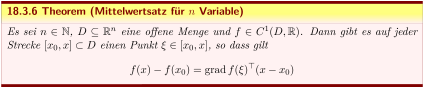
\newtcbtheorem[use counter from=Definition]{YetAnotherTheorem}{Theorem}%

  {theorem style=change apart,enhanced,arc=0mm,outer arc=0mm,

  boxrule=0mm,toprule=1mm,bottomrule=1mm,left=1mm,right=1mm,

  titlerule=0mm,toptitle=0mm,bottomtitle=1mm,top=0mm,

  colframe=red!50!black,colback=red!5!white,coltitle=red!50!black,

  title style={top color=yellow!50!white,bottom color=red!5!white,

    middle color=yellow!50!white},

  fonttitle=\bfseries\sffamily\normalsize,fontupper=\normalsize\itshape,

  }{theo}


\begin{YetAnotherTheorem}{Mittelwertsatz f\"{u}r $n$ Variable}{mittelwertsatz_n2}%

  Es sei $n\in\mathbb{N}$, $D\subseteq\mathbb{R}^n$ eine offene Menge und

  $f\in C^{1}(D,\mathbb{R})$. Dann gibt es auf jeder Strecke

  $[x_0,x]\subset D$ einen Punkt $\xi\in[x_0,x]$, so dass gilt

  \begin{equation*}

  f(x)-f(x_0) = \operatorname{grad} f(\xi)^{\top}(x-x_0)

  \end{equation*}

\end{YetAnotherTheorem}

% \usepackage{varwidth}   \tcbuselibrary{skins}

\newtcbtheorem[use counter from=Definition]{YetAnotherTheorem}{Theorem}%

{enhanced,frame empty,interior empty,colframe=ForestGreen!50!white,

  coltitle=ForestGreen!50!black,fonttitle=\bfseries,colbacktitle=ForestGreen!15!white,

  borderline={0.5mm}{0mm}{ForestGreen!15!white},

  borderline={0.5mm}{0mm}{ForestGreen!50!white,dashed},

  attach boxed title to top center={yshift=-2mm},

  boxed title style={boxrule=0.4pt},varwidth boxed title}{theo}


\begin{YetAnotherTheorem}{Mittelwertsatz f\"{u}r $n$ Variable}{mittelwertsatz_n3}%

  Es sei $n\in\mathbb{N}$, $D\subseteq\mathbb{R}^n$ eine offene Menge und

  $f\in C^{1}(D,\mathbb{R})$. Dann gibt es auf jeder Strecke

  $[x_0,x]\subset D$ einen Punkt $\xi\in[x_0,x]$, so dass gilt

  \begin{equation*}

  f(x)-f(x_0) = \operatorname{grad} f(\xi)^{\top}(x-x_0)

  \end{equation*}

\end{YetAnotherTheorem}
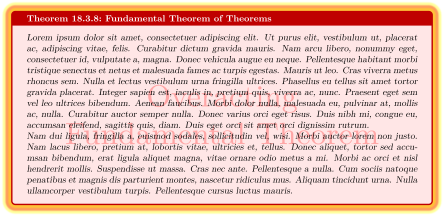
You need more attention for your theorems? Here, you are …
% tcbuselibrary{skins}  % preamble

\begin{Theorem}[enhanced,

    fuzzy halo=3mm with yellow,

    fuzzy halo=2mm with red,

    fuzzy halo=1mm with yellow,

    watermark color=red!35!white,

    watermark text={Overacting\\Fundamental Theorem}]%

  {Fundamental Theorem of Theorems}{fundamental}%

  \lipsum[1-2]

\end{Theorem}
Let’s try a more conservative approach:

% \tcbuselibrary{skins}

\newtcbtheorem[use counter from=Definition]{YetAnotherTheorem}{Theorem}%

  {theorem style=plain,enhanced,colframe=blue!50!black,colback=yellow!20!white,

   coltitle=red!50!black,fonttitle=\upshape\bfseries,fontupper=\itshape,

   drop fuzzy shadow=blue!50!black!50!white,boxrule=0.4pt}{theo}


\begin{YetAnotherTheorem}{Mittelwertsatz f\"{u}r $n$ Variable}{mittelwertsatz_n4}%

  Es sei $n\in\mathbb{N}$, $D\subseteq\mathbb{R}^n$ eine offene Menge und

  $f\in C^{1}(D,\mathbb{R})$. Dann gibt es auf jeder Strecke

  $[x_0,x]\subset D$ einen Punkt $\xi\in[x_0,x]$, so dass gilt

  \begin{equation*}

  f(x)-f(x_0) = \operatorname{grad} f(\xi)^{\top}(x-x_0)

  \end{equation*}

\end{YetAnotherTheorem}
18.4 Using other theorem environments with tcolorbox
Instead of creating theorem environments with the methods described before, environments from other packages can be boxed with a tcolorbox.
Environments may be created e. g. by methods from the theorem package or the amsthm package. \tcolorboxenvironment can be used to put a box around these environments.
\usepackage{amsthm}


\theoremstyle{plain}%    from `amsthm'

\newtheorem{lem}{Lemma}% from `amsthm'


\tcolorboxenvironment{lem}{

  enhanced jigsaw,colframe=cyan,interior hidden,

  breakable,before skip=10pt,after skip=10pt }


\tcolorboxenvironment{proof}{% `proof' from `amsthm'

  blanker,breakable,left=5mm,

  before skip=10pt,after skip=10pt,

  borderline west={1mm}{0pt}{red}}
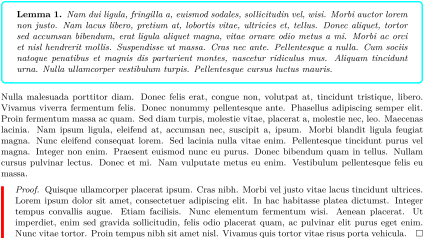
\begin{lem}

  \lipsum[2]

\end{lem}


\lipsum[3]


\begin{proof}

  \lipsum*[4]

\end{proof}